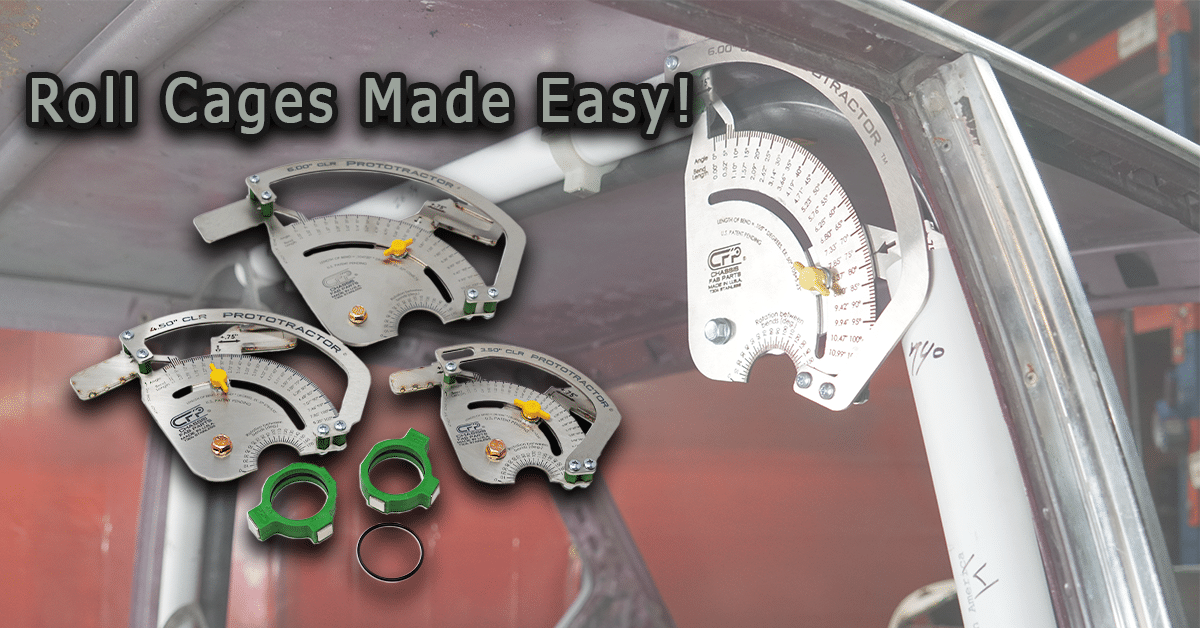
Before you bend a single stick of steel, you need to know three things about every bend in your layout: the angle, the rotation, and the straight length between bends. Get any one of those wrong and the tube does not fit. On a roll cage or handrail with a dozen bends, one bad input means starting over.
There are two ways fabricators work out those numbers: CAD software or a physical mockup. Both can get you to the right answer. Which one gets you there faster, with fewer mistakes, and without requiring a computer science degree to operate?
The real problem with CAD for tube layout
CAD is a powerful tool and it has a legitimate place in fabrication. Designing machined parts, structural weldments with tight tolerances, or anything documented for a customer handoff is where CAD earns its keep. Working out bend sequences on a tube chassis or cage is where it creates more problems than it solves.
The core issue is visualization. Tube with multiple bends in different planes is difficult to model correctly in CAD and harder still to verify. Rotation angles between bends are easy to get wrong on screen. A 5-degree error in a rotation angle does not look like much in a drawing. On a cage hoop that has to clear a door opening, it means the tube does not fit.
Beyond the accuracy problem, CAD requires software, a computer, and someone who knows how to use both. In a shop, that means stopping work, going to a desk, building the model, then translating numbers from the screen back to the bender. Every handoff between drawing and shop floor is another opportunity for error.
What a physical layout tool actually does
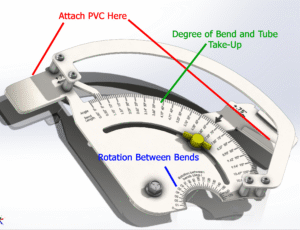
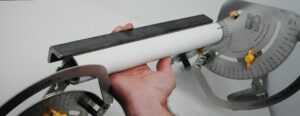
This layout tool works differently. Each component simulates a bent section of tube at a specific CLR, built at full scale with PVC pipe as the stand-in material. You assemble the mockup in real space, fitting PVC between components until the layout matches the actual installation. When it fits in three dimensions, you read the angles and straight lengths directly off the physical model.
That process eliminates the visualization problem entirely. There is no drawing to interpret. Instead, you see the actual shape the tube needs to take, in the space where it needs to fit. Rotation angles that are easy to misread on screen become obvious in person. Clearance problems that would not appear until the steel was bent show up during the mockup, when PVC is still the material being modified.
What you read off the mockup
Once the mockup fits, you have everything you need to go to the bender. Bend angles read directly off each component. Straight lengths between bends measure from the mockup with a tape. Rotation angles between bends are visible in the physical model in a way that CAD simply cannot replicate for a non-expert user. The whole process is faster, and the first bend sequence is far more likely to produce a tube that fits on the first try.
Where this tool earns its keep
Roll cages
Roll cages are the most demanding tube layout challenge most fabricators will face. Main hoops, door bars, roof bars, and harness bars intersect at compound angles with tight clearance requirements. The stakes are high because a cage that does not fit correctly either gets cut apart and redone or ends up with compromise joints that reduce structural integrity. Working the layout out in PVC before touching steel removes most of that risk.
Handrails and architectural work
Handrail work that involves returns, rakes, and wall returns in multiple planes is another area where physical mockup outperforms CAD. In handrail work, the install environment becomes the design tool. You fit the mockup to the actual staircase or wall, confirm the geometry, then read your numbers. The alternative is measuring the space, building a CAD model, then hoping the dimensions were accurate enough that the tube fits on installation day.
Exhaust and intake routing
Routing tube around engine components, frame rails, and body panels in tight engine bays is exactly the kind of problem physical mockup solves well. You work around actual obstacles instead of estimating clearances in a drawing. The PVC bends where you need them to, and the final layout reflects the actual space rather than an approximation of it.
Training and education
The layout tool is one of the most effective training aids available for teaching tube bending concepts. Bend-plane rotation is a concept many students struggle to grasp from a drawing or a verbal explanation. Holding the mockup and rotating a section to see how it changes the tube path makes the concept immediately clear. Welding programs, high school fab classes, and vocational training centers have used this tool to accelerate understanding of multi-plane bend layout in ways no drawing or CAD exercise matches.

The tool set and pricing
The layout tool starts at $87 for the smallest size, built around a 3.5″ CLR. A full set covering the CLR options used in a typical roll cage build runs around $500. Every component is built in the USA. The patent application is pending (US App 18589068).
Sets are available by CLR size to match the die set you are already running. If you are building with RogueFab dies at 2.5″, 3.5″, 4.5″, or 6″ CLR, the matching layout tool components are available to fit your existing setup. You can find the full selection on the layout tool product page.
CAD still has a place
This is not an argument against CAD. For shops doing complex structural engineering, producing documentation packages, or designing parts for CNC machining, CAD is indispensable. The argument is narrower: for working out bend sequences on tube that needs to fit in a real space, a physical mockup is faster and more accurate for most fabricators in most shop environments. Use the right tool for the right job. For tube layout, that usually means a physical mockup, not a screen.