
Not all tube bending is the same. The method you choose determines bend quality, cross-section deformation, tooling requirements, and whether you can repeat the bend accurately on the next piece. Choose the wrong method and you get wrinkles, flat spots, or bends you cannot reproduce when it counts.
This article covers every major bending method used in fabrication shops, with real machine names in each category. For the underlying geometry, including CLR, wall ratio, springback, and D/R math, the Bender Tech page covers those fundamentals. What follows goes further into how each method works and where it belongs.
Rotary Draw Bending
Rotary draw bending is the standard for precision fabrication work. A bend die with a fixed centerline radius pulls the tube around its profile. A clamp die holds the tube against the bend die, and a pressure die supports the outside wall as the tube wraps around. Together, those three components produce a bend with a known, repeatable CLR, controlled cross-section deformation, and the accuracy that roll cage builders, chassis fabricators, and structural shops depend on.
The CLR is fixed per die, and every die is a specific radius. That sounds like a constraint, but it is actually a feature. Once you confirm a 1.75″ tube on a 4.5″ CLR die fits your application, every subsequent bend on that die hits the same radius. In other words, repeatability is built directly into the tooling.
Current Production Machines
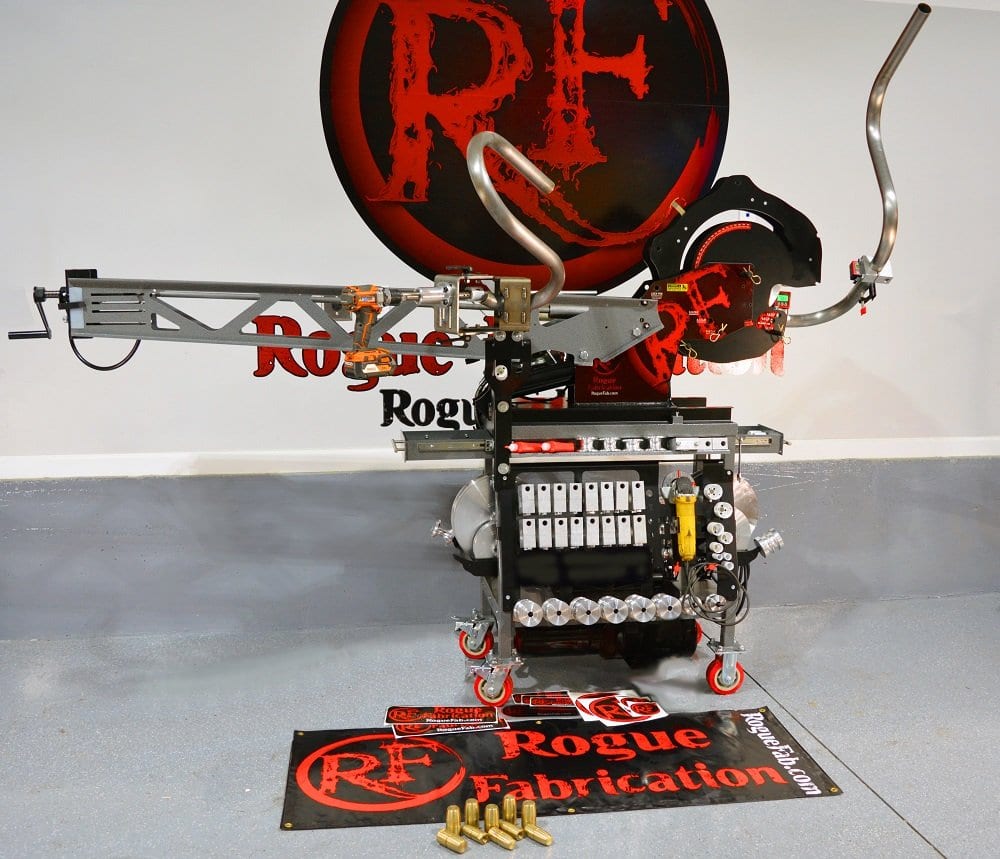
The RogueFab M6xx series covers three frame sizes that all share one die ecosystem. The M601 handles tube up to 1-3/4″ OD at .156″ wall. Stepping up, the M605 handles 2.00″ at .188″ wall and completes 90-degree bends in a single ram stroke. At the top of the line, the M625 is rated for 2.00″ x .250″ wall DOM under warranty daily, with 66% more frame material than the M601. All three share the same 50-plus die sizes, the same cart, the same backstop, and the same mandrel attachment, with CLR options at 2.5″, 3.5″, 4.5″, and 6″.
Beyond the M6xx, several other current machines are worth knowing. The JD2 Model 3 and Model 32 are widely used in both home and professional shops. Pro-Tools makes the 105 and 105HD. The TubeShark has a solid following in the roll cage community. Meanwhile, Baileigh’s RDB series covers manual through semi-automatic hydraulic, and Ercolina machines are common in professional shops handling larger diameters.
Used Market Machines
The used market adds even more depth to this category. Di-Acro benders are still manufactured but appear regularly on the used market and hold up well. Hossfeld No. 2 benders have been in continuous production for over 100 years, with a massive third-party die ecosystem that makes them common in ornamental metalwork and bar bending. Pines benders are industrial horizontal machines that surface in used equipment auctions, and Conrac and Eaton Leonard CNC machines appear when manufacturing facilities close.
Mandrel Bending
Mandrel bending is not a separate machine category. Rather, it is rotary draw bending with an internal support inserted into the tube before the bend starts. The machine itself is identical; the mandrel is simply the addition that changes what it can do.
Without a mandrel, the inside wall of a tight bend has nowhere to go except inward. On thin-wall tube or tight CLR-to-diameter ratios, that means wrinkling on the inside of the bend and flattening on the outside. Adding a mandrel supports the tube from the inside and maintains the cross section through the bend zone. That is often the difference between a clean part and a scrapped one.
Bullet Mandrel vs Ball Mandrel
There are two main mandrel types used in fabrication. A bullet mandrel is a single solid insert with a tapered nose, positioned just inside the tangent point. It handles the majority of mandrel bending applications in a shop setting. Ball mandrels, on the other hand, use linked spheres that articulate through the bend zone, providing support closer to where deformation actually starts. As a result, ball mandrels are reserved for the most demanding combinations of thin wall and tight CLR. The M6xx uses bullet mandrels, which is the right choice for most structural and exhaust work. For the most aggressive thin-wall applications, wiper dies can also be added to further control distortion.
What Mandrel Bending Costs
The cost picture here is worth understanding clearly. The M6xx mandrel attachment with tooling for one diameter runs approximately $2,500. The next step up, a dedicated semi-automatic mandrel bender from a manufacturer like Ercolina, starts around $60,000 without tooling. BLM Group and Eaton Leonard production mandrel benders run well beyond that. For a shop doing tight-radius exhaust work, roll cage tubing, or thin-wall applications where a standard rotary draw bend is not clean enough, the M6xx attachment covers that gap. Nothing else comes close at that price.
Ram / Compression Bending
Ram bending uses a center die pressed hydraulically into a tube supported by two pivoting shoes. As the ram travels, the tube deforms against the center die and takes on the bend. This is the standard method in muffler shops and exhaust repair shops, and machines like the BendPak exhaust bender and Mittler Brothers benders all work on this principle.
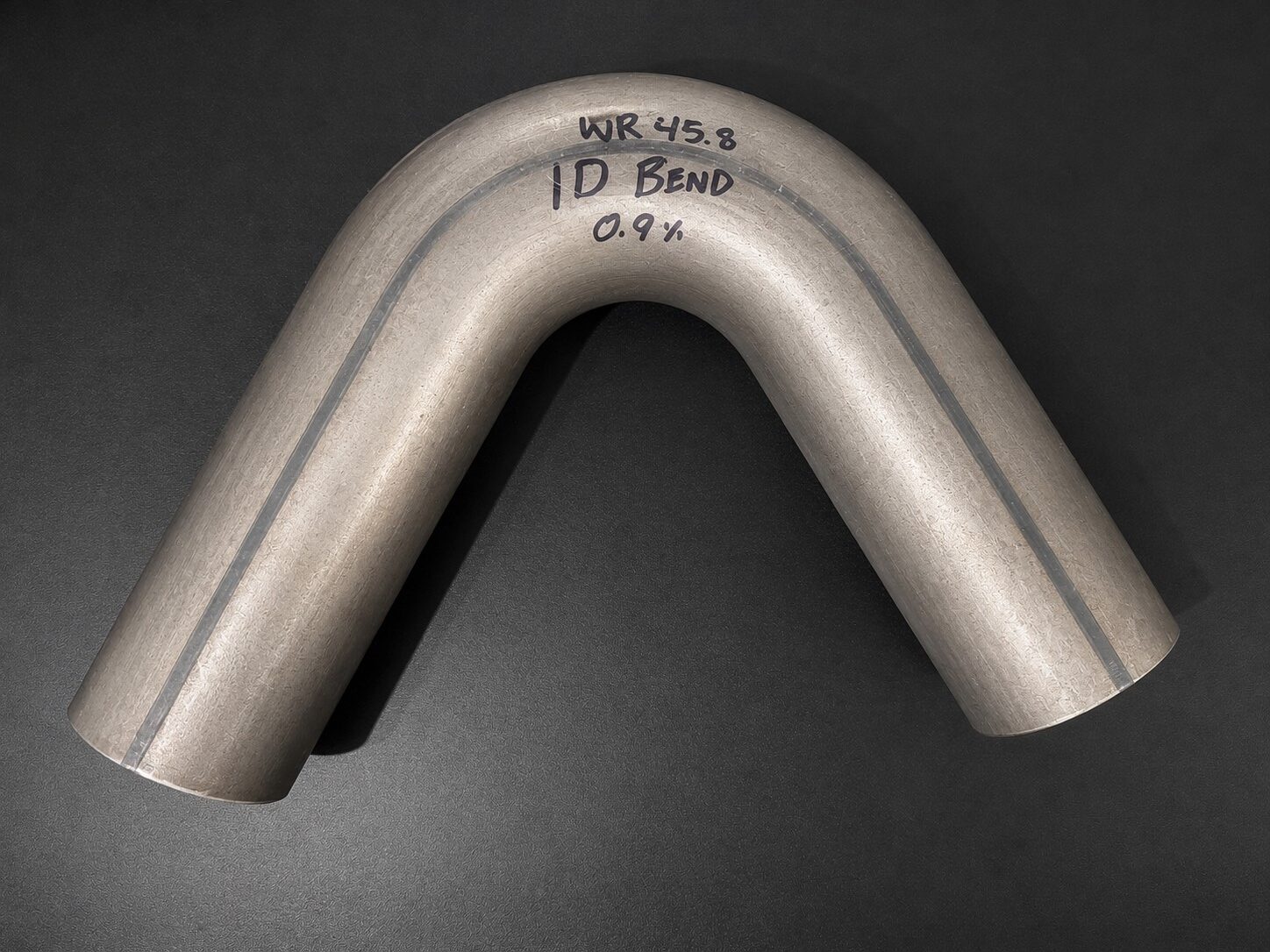
The main tradeoff is cross-section deformation. Ram bending flattens the outside and inside of the bend more than rotary draw does, which reduces flow area somewhat. For exhaust pipe, though, that is generally acceptable. A muffler shop bending 100 pipes a week prioritizes throughput over tight tolerances, and ram bending delivers speed and simplicity at low tooling cost. For structural tube, however, that level of deformation is not acceptable.
Even so, ram bending remains the standard in exhaust shops for good reason. One distinction worth making: A-frame bottle jack benders, such as the KAKA-style and Affordable Bender setups, are not exhaust-style ram benders. Those are press benders designed for conduit and light plumbing, which is a different category covered in the next section.
Roll Bending
Three-roll bending uses three rollers arranged in a triangle. As the tube passes through, it curves to a radius determined by the roller spacing. Unlike rotary draw bending, the CLR is not fixed to a die. Instead, you adjust the roller spacing and run the tube through until the radius lands where you need it. That adjustability makes roll bending the right method for large-radius curves, gentle sweeps, and complete rings where no fixed-CLR die would work.
Common applications include architectural metalwork, furniture, decorative railings, and custom hoops. Because roll bending does not produce tight bends, it is the wrong tool for a roll cage node. At the same time, it is exactly the right tool for a handrail that sweeps around a curved staircase. Machines in this category include the Ercolina three-roll, Baileigh R-M10, Di-Acro roll benders, and Hossfeld setups configured with roll dies. RogueFab also has a tube roller currently in development.
Press Bending
Press bending uses a ram to push a center form into a tube supported at two fixed points. It is the simplest bending method available and also produces the most cross-section deformation of any method covered here. The resulting radius varies with how far the ram travels, and bend quality depends on how well the two support points are positioned relative to the bend zone.
A-frame bottle jack benders fall into this category, including the KAKA AB-40, the Affordable Bender, and similar setups. These work acceptably on conduit and light plumbing tube. For structural applications, though, they are not appropriate. Wall thinning and ovalization at the bend zone are not acceptable for load-bearing tube like cage tubing or chassis crossmembers. Greenlee conduit benders are also press benders, designed specifically for electrical conduit, and they work well for exactly that purpose.
In short, press bending gets the job done cheaply for conduit and non-structural light-wall bends. For anything structural, it is the wrong method.
CNC and Automated Rotary Draw Bending
CNC tube bending is rotary draw bending with programmable multi-axis control layered on top. The machine handles part positioning, bend sequence, and rotation automatically, which eliminates manual measurement between bends and allows complex multi-bend parts to run from a stored program. This is production fabrication: high-volume automotive and aerospace components, HVAC and fluid line assemblies, and applications where hundreds of identical parts must hit the same tolerances every run.
The major manufacturers in this space are BLM Group, Eaton Leonard, Unison, Schwarze-Robitec, and Addison McKee. These are not shop machines. They are production assets that cost as much as a house, require trained CNC operators, and belong in a manufacturing environment rather than a fabrication shop.
The Affordable Entry Point
For shops moving toward production-quality repeatability without that capital investment, the electric hydraulic option on the M6xx series paired with the auto bend stops accessory is a practical starting point. That combination delivers consistent hydraulic force on every bend and removes the operator variable from bend angle. It is not a full CNC, but it is a meaningful step toward repeatable results on a manual bender platform.
Choosing the Right Method
Ultimately, the decision comes down to four things: what you are bending, how tight the radius needs to be, what cross-section quality the application demands, and how many times that bend needs to be reproduced. Get clear on those four points first, and the right method becomes obvious.
Rotary draw bending is the right starting point for any structural application, including roll cages, chassis, handrails, intake piping, and exhaust headers. The fixed CLR and controlled deformation give you the accuracy that structural work requires. When the wall-to-diameter ratio or the CLR-to-diameter ratio pushes into territory where standard rotary draw leaves distortion you cannot accept, that is when you add a mandrel.
Beyond rotary draw, each method has a clear home. Ram bending belongs in exhaust and muffler repair. Roll bending belongs in architectural and ornamental work with large-radius curves. Press bending belongs in conduit and light plumbing. CNC belongs in production manufacturing. Knowing where each method fits keeps you from buying tooling that cannot do the job, or overbuilding a setup for work a simpler machine handles fine.
If you are setting up a shop or upgrading to something that handles structural work, the M6xx series covers the range from home shop builds to daily professional production. The die ecosystem carries forward as the work scales up.