Most fabricators don’t bend titanium. They pie cut it.
You’ve seen it: a stack of little wedge-cut sections, carefully mitered and TIG welded back together to approximate a bend. It takes hours. It adds weight in filler. It puts heat into the tube repeatedly. And the result, if you’re honest, looks like what it is — a workaround.
The reason people pie cut titanium isn’t that they prefer it. It’s that their bender can’t handle the material. So they adapt.
We got curious about what the M6xx could actually do with titanium. What follows is what we found.
(The M6xx refers to our current line of tube and pipe benders — the M601, M605, and M625. Same platform, different capacity levels. More on that here.)
Why Titanium Is Genuinely Difficult to Bend
Titanium isn’t just expensive steel. It has its own personality, and if you don’t account for it, it’ll wrinkle, crack, or spring back far enough to ruin your layout.
A few things that make Ti different from steel and even stainless:
Springback is significant. Ti has a high strength-to-modulus ratio, which means it wants to return toward its original shape after bending. You have to overbend intentionally and dial in your springback compensation — this takes test bends, not guesswork. The grade and temper of your material matter a lot here.
Wall support is critical. Thin-wall titanium will collapse or wrinkle on the intrados (inside of the bend) if it isn’t supported during the bend. This is exactly why mandrel bending exists. Without a mandrel, your options with thin-wall Ti are limited to large CLR dies and accepting mediocre results.
Lubrication matters more than you think. Ti has a tendency to gall — it doesn’t like dry sliding contact with tooling. The right lubricant makes a measurable difference in bend quality and mandrel extraction.
Alloy and temper are everything. There’s a huge range of titanium alloys. Fully annealed material bends. Cold-worked or aged material does not forgive you the same way. Know what you’re ordering.
What We Bent — The Test Data
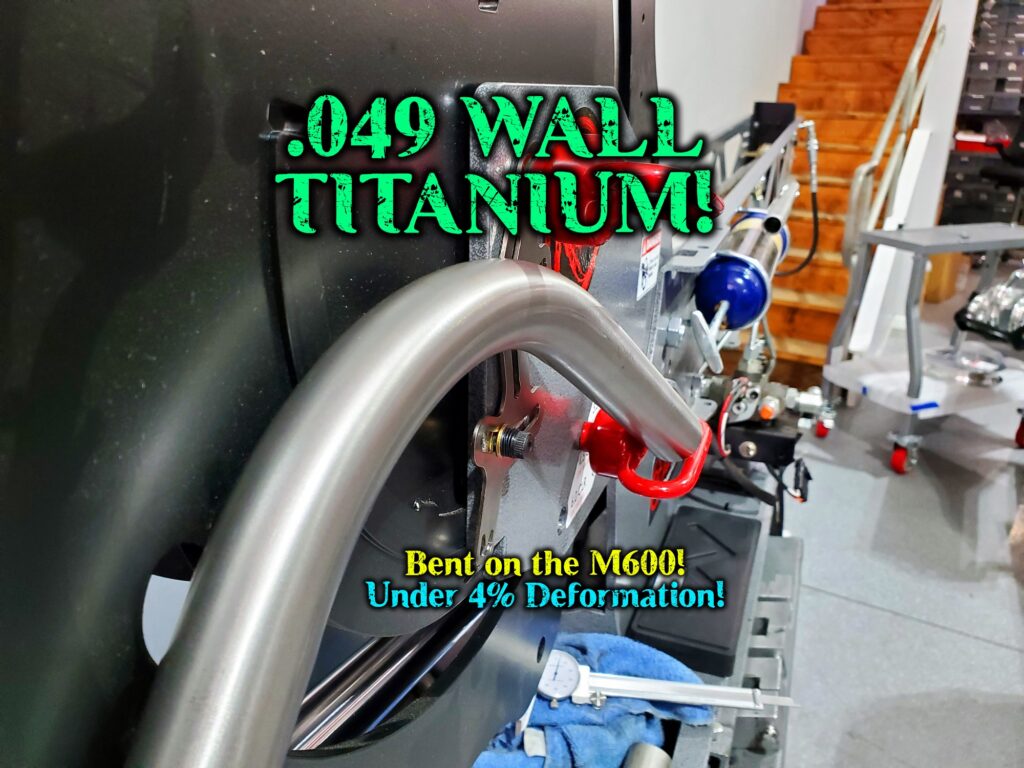
Bend 1 — Customer Job: 1.25″ x .049 wall, 13W Titanium
13W is a Russian/Eastern European alloy designation for Ti-3Al-2.5V, equivalent to ASTM Grade 9. It’s widely used in high-performance exhaust systems, motorsport tubing, and aerospace applications where Grade 2 isn’t strong enough and Grade 5 (6Al-4V) is too difficult to form. This particular material was fully annealed — the right condition for bending.
- Material: 13W (Ti-3Al-2.5V), fully annealed
- OD x Wall: 1.25″ x .049″
- CLR: 3.5″
- Machine: M6xx with Mandrel Attachment, electric/hydraulic power
- Deformation: Under 4%
- Lubrication: Bend All 002 (formulated for non-ferrous applications with industrial bronze mandrels)
- Bend speed: ~3.5 degrees per second
- Mandrel position: Full nose diameter just ahead of tangency (bend start)
A note on the deformation figure: we ran short on test material during mandrel tuning. With more stock to dial in the setup, we’re confident sub-2% deformation was achievable on this size. That’s a number that competes directly with $30,000+ dedicated mandrel benders.
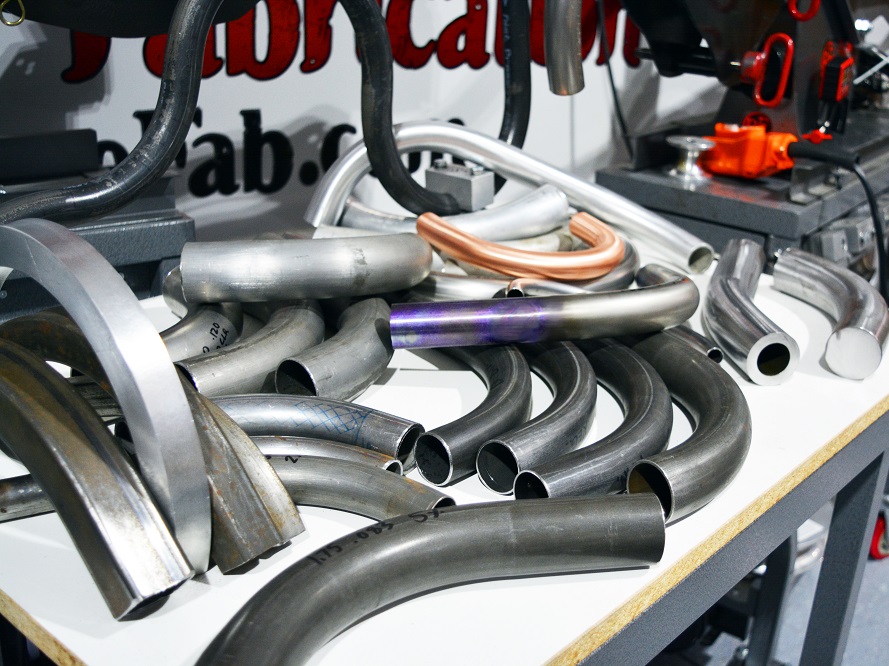
Bend 2 — In-House Testing: 1.50″ x .070 wall, Ti-3Al-2.5V
Our own test stock, purchased specifically to push the machine’s capability. Most of what we sourced was Ti-3Al-2.5V, the same alloy family as 13W and one of the most commonly used grades for structural and exhaust work.
- Material: Ti-3Al-2.5V (annealed)
- OD x Wall: 1.50″ x .070″
- CLR: 4.5″
- Machine: M6xx with Mandrel Attachment, electric/hydraulic power
- Lubrication: Bend All 002
- Bend speed: ~3.5 degrees per second
The goal was structural — could this machine produce bends you’d trust in a frame or roll structure? Yes. But the more immediate market is exhaust. Ti exhaust systems for motorcycles, sports cars, and race vehicles are everywhere, and the builders who can bend their own tube instead of pie cutting have a serious time and quality advantage.
That purple iridescent color you see in the pile photo? That’s titanium. It’s not a filter. Titanium oxidizes with heat, and the color tells you about the temperature it reached — similar to how you read heat colors on stainless welds. A light gold or purple is fine. Blue or grey means it got too hot.
The Pie Cutting Problem
Here’s the math on why this matters commercially.
A typical pie-cut bend requires calculating and cutting 6–12 individual wedge sections per bend, carefully fitting and tacking each joint, full TIG welding every seam, post-weld cleanup and inspection, and multiple heat cycles into the same tube.
A mandrel bent Ti tube is one piece, one smooth arc, no welds in the bend zone. Less time. Less filler. Less distortion. Cleaner final product. For an exhaust fabricator building custom Ti systems, the ability to actually bend tube is a direct competitive advantage — you can build in a day what takes a pie cutter three.
Setup Notes for Ti Bending on the M6xx
This isn’t a complete how-to — every size and alloy will need its own dialed-in setup. But here’s what worked for us and is worth knowing before you start burning material:
Mandrel position: Full nose diameter just ahead of the tangency point (the start of the bend). This is the same setup principle as stainless, but Ti gives you less forgiveness if you’re too far back.
Lubrication: We used Bend All 002. It’s formulated specifically for non-ferrous materials with industrial bronze mandrels — which is exactly what our mandrel attachment uses. Don’t skip lube, and don’t use the wrong lube. Ti will gall on dry tooling.
Bend speed: Around 3.5 degrees per second using our electric/hydraulic system. Slow and controlled. This is one of the reasons the electric/hydraulic setup is the right choice for exotic materials — you have consistent speed throughout the bend, not the surge-and-stall of a manual or air-over-hydraulic setup.
Overbend for springback: Dial in your springback on scrap before you commit to finished tube. Ti springs back more than mild steel. How much depends on your alloy, wall thickness, and CLR. There’s no shortcut here — test bends are part of the process.
Anneal if possible: Fully annealed material is significantly more forgiving. If you’re sourcing your own Ti stock, specify annealed condition for bending applications.
What About Other Exotic Alloys?
If you’re building systems where temperature and corrosion resistance are the spec, titanium is usually one option on a short list. Two others worth knowing about:
Sandvik 2507 Super Duplex Stainless — extremely high corrosion resistance, commonly used in refinery and offshore applications. We’ve bent 2507 on the M6xx. It typically runs heavier wall than Ti exhaust work, and we’ve generally done those without the mandrel for that reason. High strength means you need to be on the right side of your capacity chart.
Inconel — nickel-chromium superalloy used where both temperature and corrosion resistance matter simultaneously. Turbo manifolds, exhaust collectors on high-horsepower race engines, industrial heat exchangers. We haven’t formally tested Inconel bending on the M6xx yet — it’s on the list. Like Ti and 2507, it’s in the family of materials that most shops outsource or work around with pie cutting. If you’re working with Inconel and want to collaborate on a bending test, get in touch.
The Machine That Makes This Possible
None of this happens without the mandrel attachment. The standard M6xx is an excellent bender for steel, stainless, aluminum, and chromoly. Add the mandrel attachment and the electric/hydraulic system, and you’re in a different category — capable of the kind of thin-wall exotic bending that most shops either outsource, avoid, or work around with pie cutting.
The nearest competitor mandrel bender with real metal mandrels starts at $60,000 without tooling. Our system starts at a fraction of that.
See the M6xx Mandrel Attachment →
More Ti Content Coming
We have more titanium stock here and more testing planned. A video documenting the full Ti bending setup — machine config, lube application, mandrel position, test bend sequence — is in production. We’ll update this page when it’s live.
If you’ve bent Ti on an M6xx and have results to share, we want to hear about it. Comment below.