Best Tube Benders Compared: A Mechanical Engineer’s Honest Take
There are four categories of rotary draw tube bender on the market. They are not interchangeable. The right machine for a roll cage fabricator is not the right machine for a hobbyist doing occasional exhaust bends, and neither of those is the right machine for someone doing large-radius architectural work. This article walks through each category, covers the specific machines worth knowing about, and is honest about where each one fits and where it does not.
How to Read This Article
We make the M6xx series. That is not a secret and it is not something we are going to pretend away. What we will do is give you a straight comparison of the machines in each category, tell you what they are good at, and tell you what they are not. We have been selling tube benders since 2010. We have handled the support calls that come after a bad machine decision and we have talked to fabricators who came to us after outgrowing machines they bought elsewhere. The perspective in this article is real.
One ground rule: no scores out of 10. A number attached to a complex mechanical product with a wide range of use cases is not useful information. What matters is whether the machine fits your application.
The article is organized by machine category. If you already know what type of bender you need, jump to that section. If you are not sure, read straight through. The category differences matter more than the brand differences.
The Four Types of Tube Bender
Rotary draw benders
The standard for structural fabrication, roll cage work, motorsports, and any application where consistent, repeatable fixed-radius bends are required. A bend die rotates around a fixed center point, drawing the tube around it with a clamp die on the leading side and a pressure die on the trailing side. The result is a clean bend with defined geometry. All the machines covered in this article are rotary draw benders unless otherwise noted.
Mandrel benders
A specialized category of rotary draw bender that adds a mandrel rod inside the tube at the tangent point during the bend. Used for thin-wall applications, tight D/R ratios, and any work where cross-section consistency matters: performance exhaust, intercooler piping, aerospace tubing. Covered in full on our mandrel bending page.
Roll benders
Three-roll pyramid benders for large-radius sweeping curves: architectural work, boat rails, curved structural members. Not a substitute for rotary draw bending. Different machine, different result.
Ram / compression benders
A die presses into the tube from the outside while two support shoes hold the back. Fast setup, low cost, significant deformation at the bend. Acceptable for OEM exhaust repair and simple non-structural work. Not appropriate for roll cage primary structure, performance exhaust, or anything where cross-section consistency matters.
Vertical vs. Horizontal: Why Orientation Matters
The most important structural difference in the rotary draw bender market is orientation, vertical vs. horizontal, and it is not discussed nearly enough in comparison articles.
Horizontal arm-frame benders
The traditional design. The die axis is horizontal, the arm sweeps in a horizontal plane, and the tube feeds horizontally into the machine. The bending torque generated by the arm acts against the floor. These machines must be anchored to the floor with concrete anchors to be used safely. This is not optional and it is not a minor inconvenience. It is a real operational constraint that affects where you can set up the machine and whether it is practical for shops without a permanent concrete slab.
On multi-bend coplanar parts, gravity acts on the unsupported tube length between the machine and the last bend. For short tubes with simple bend sequences this is manageable. For longer tubes with multiple bends, gravity-induced rotation is a real source of error that requires careful technique to control.
Vertical benders
The M6xx and TubeShark are the two vertical rotary draw benders in this market. On a vertical bender, the die axis is vertical, the ram drives downward, and the tube feeds horizontally with bends going up and down. Several things change as a result.
Gravity no longer induces rotation on multi-bend parts. The tube hangs or rests naturally without pulling toward one rotation. This is a real accuracy advantage on complex coplanar bend sequences and on long tube sections.
The vertical architecture does not generate a horizontal torque load against the floor. The M6xx sits on a cart with wheels and does not need to be anchored to anything. You can roll it outside for a long tube, roll it back in, and move it to the other side of the shop if the job calls for it. That portability is not a minor feature. It determines whether a machine works in a small garage shop or only in a dedicated facility.
A standard garage ceiling is tall enough for M6xx work. For most motorsports bending, the vertical distance from the die to the last bend is around 4 feet. You are not going to hit the ceiling. If you need to put a 180-degree bend in the center of a long stick, roll the tube outside, make the bend, and roll it back. The machine goes where the work is.
Category 1: Vertical Rotary Draw Benders
RogueFab M6xx Series (M601, M605, M625)
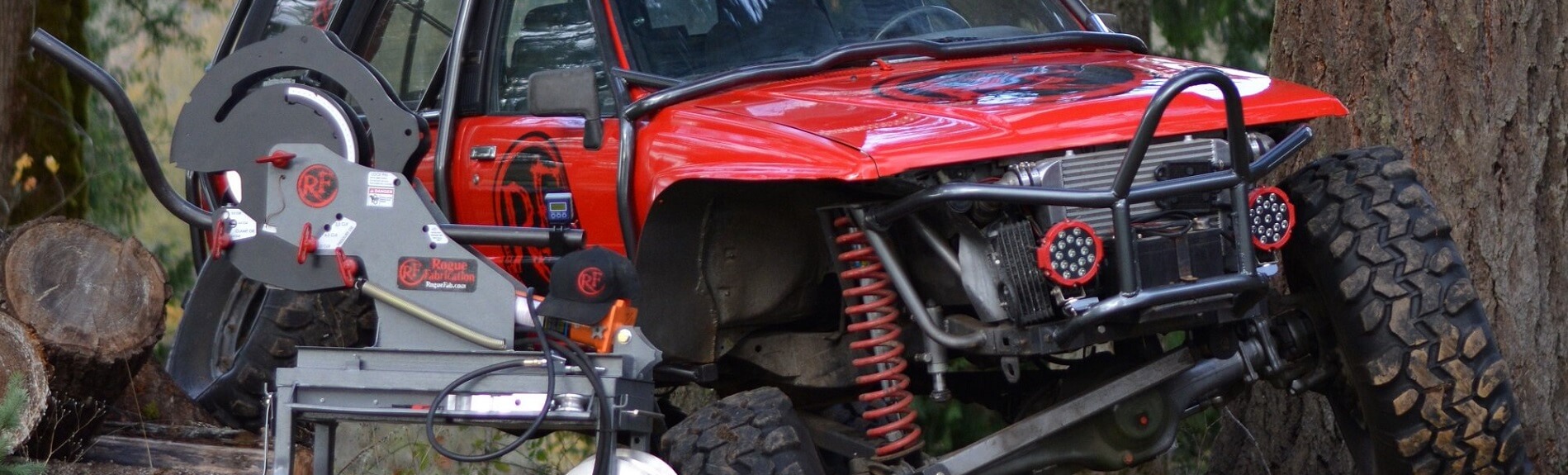
The M6xx is a vertical rotary draw bender available in three capacities: M601, M605, and M625. The frame design is covered by US Patent 11529663. Here is what each model handles:
- M601: Up to 1-3/4″ OD tube at .156″ wall. Max solid bar 1-1/8″. The standard choice for most roll cage, bumper, and general fabrication work.
- M605: Up to 2.00″ OD tube at .188″ wall, or 1-1/2″ solid bar. Completes 90 degrees in a single ram stroke. Duraplates available. The right machine for SCORE, trophy truck, and heavy structural work.
- M625: Up to 2.00″ x .250″ wall DOM daily under warranty. 1-3/4″ solid bar. Frame is 66% thicker than the M601. Duraplates standard. The machine for shops doing the most demanding work consistently.
The M601 upgrades to M605 capacity with a few pieces of hardware. The M605 to M625 upgrade requires a frame swap, but the dies, hydraulics, and cart all carry over. That upgrade path is significant: when you outgrow a JD2 or a Pro-Tools, you buy a new machine and start over. When you outgrow an M601, you spend a fraction of replacement cost and keep everything you already own.
The die ecosystem
The M6xx die ecosystem covers 50+ sizes across 1/2″ through 2″ OD tubing in CLR options of 2.5″, 3.5″, 4.5″, and 6.0″. All dies are shared across the M601, M605, and M625. A die purchased for an M601 works on an M625 without modification. No other machine in this market offers this.
The clamp block
On horizontal arm-frame machines, the clamp block is part of the die set: one clamp per die, specific to that die, purchased with it. On the M6xx, the clamp block is a separate universal component that works across the die range. What this means in practice:
- A worn clamp block is a small parts cost, not a die replacement.
- The quick-change clamp system enables fast setup for prototype and short-run work without swapping die sets.
- The clamp block functions as a precision split block for holding, fixturing, and positioning work beyond tube bending. No other machine in this category offers this.
Upgrade path
Here is what is available on the M6xx that is not available on horizontal arm-frame machines:
- Hydraulic upgrade: Factory designed, $99-249. On JD2 and Pro-Tools, hydraulic upgrades run through aftermarket suppliers like SWAG Off Road. Functional, but not factory engineered for the machine.
- Electric hydraulic with auto bend stops: Factory option on M6xx. Not available on any horizontal arm-frame machine from the original manufacturer.
- Backstop: Factory option on M6xx. Not available on JD2 or Pro-Tools.
- Thin Wall Roller: Factory option on M6xx, covered by US Patent 11679431. 10-second install. Not available anywhere else in this market.
- Mandrel attachment with bronze mandrels: Factory option on M6xx, covered by US Patent 11478838. RogueFab is the only manufacturer offering a mandrel attachment with metallic (bronze) mandrels in this market. That is the industry standard mandrel material. Not available on any horizontal arm-frame machine from the original manufacturer.
- Rotation gauges: Factory option on M6xx. Not available on competing machines.
- Full cart system: Factory designed, integrates die storage, hydraulics, and mobility. Competing machines offer a pedestal mount at best.
Made in USA
The FTC requires that all or virtually all of a product be domestically produced for an unqualified Made in USA claim. A major imported component disqualifies the claim regardless of where the company is based or where assembly occurs. The M6xx frame and dies meet the FTC standard for domestic manufacturing. The hydraulic options include imported cylinders, which is why the complete machine does not carry an unqualified Made in USA claim. That is the honest answer and we give it.
We encourage you to ask the same question of any bender manufacturer you are considering. Ask specifically about hydraulic component origin. We will not audit other manufacturers’ supply chains in this article. We will tell you what the standard is, tell you our answer, and let you ask the question yourself.
Reviews
RogueFab averages 5.0 stars across Google Reviews, not because negative reviews are removed, but because they are buried under genuine positive ones. We publish negative reviews on product pages too. That posture reflects real confidence in the product. Look up our reviews, then look up whoever else you are considering. The numbers are public.
YouTube and tech resources
23,000+ subscribers on the RogueFab YouTube channel. Real project videos: roll cages, exhaust systems, rock sliders, motorsports builds, material comparisons, ROI breakdowns. Not product pitches.
The free tech tools available at roguefab.com do not exist elsewhere in this market: the tube strength and material comparison calculator, the bend quality calculator, the capacity chart, and the Bender Tech page. When you buy an M6xx you are buying into an ecosystem of support tools that no other manufacturer in this category has built.
TubeShark
TubeShark is the other vertical rotary draw bender in this market. It is worth knowing it exists. Beyond that, we are going to let fabricators who have used both machines draw their own conclusions. Search for TubeShark reviews and used TubeShark machines for sale. The pattern in the results tells you what you need to know.
Category 2: Horizontal Arm-Frame Benders
JD2, Pro-Tools, JMR, and Woodward Fab are all horizontal arm-frame rotary draw benders. They share a common architecture: a bend die mounted on a horizontal spindle, an arm that sweeps in a horizontal plane, and a clamp-and-pressure die system specific to each die. They require floor anchoring with concrete anchors for manual use. Hydraulic upgrades are available through aftermarket suppliers. SWAG Off Road makes hydraulic kits that fit most of these machines, but they are not factory-engineered for the specific machines.
These machines are a legitimate choice for shops that have a permanent concrete floor, do not need the M6xx upgrade path, and are working within the capacity range these machines cover. They have been around for decades and there is a reason for that.
JD2 Model 3 and Model 32
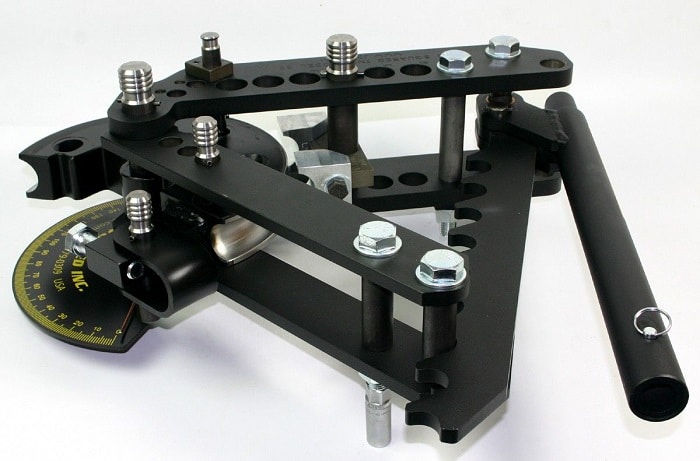
The JD2 Model 32 is the current production version of a design that has been in the market for over 25 years. CNC-machined steel construction, good build quality, solid reputation. It bends tube up to 2″ OD and handles the range of materials needed for most cage and chassis work. A 36-inch telescopic handle is included. Degree indicator wheel on the machine.
The die selection for JD2 is good. Lead times on dies are a real issue. Most are made to order, with lead times of weeks to months depending on the size. Factor this into your planning if you are buying into this ecosystem.
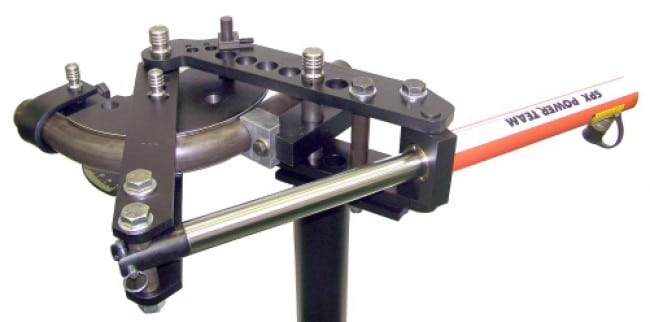
Hydraulic upgrades: JD2 does not sell a hydraulic kit designed for the Model 32. SWAG Off Road and a few other aftermarket suppliers make kits that work. The SWAG kit runs in the $300-500 range. It works, but it is not a factory system. Warranty questions get complicated when third-party components are involved. JD2 has publicly stated they cannot assess warranty claims when third-party components are in use.
Must be anchored to the floor for manual operation. Concrete anchors not included, not optional.
Pro-Tools 105 and 105HD
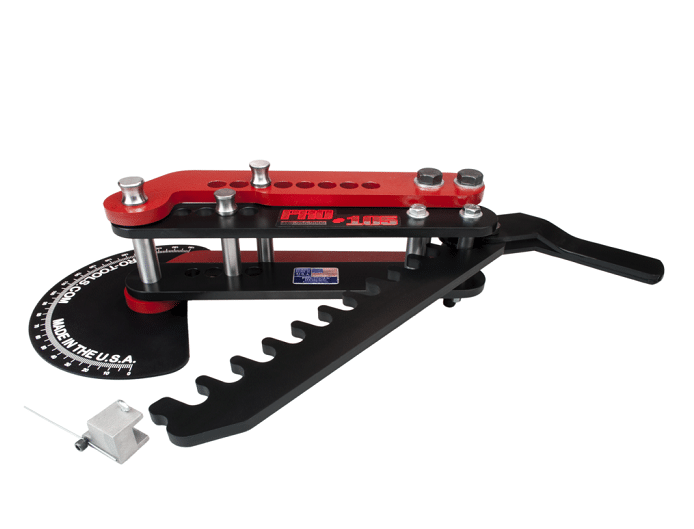
Similar category to the JD2 Model 32. The 105 is rated by the manufacturer for steel schedule 40 tubing. If you are bending other materials, confirm with Pro-Tools before ordering. Maximum capacity 2″ OD on the 105, 2.5″ OD on the 105HD. Both bend to 180 degrees. Build quality is comparable to the JD2.
The 105HD comes with an air/hydraulic pump included, which is a meaningful value difference over the JD2 hydraulic path. The hydraulics are single-acting: powered for bending, spring return for retraction. This is substantially slower than double-acting systems with powered return. If production throughput matters, factor this in.
Degree dial is not included on the base 105. It is an additional purchase. Stand is not included on the 105. The 105HD includes a stand.
Floor anchoring required for manual operation, same as JD2.
JMR Raceline
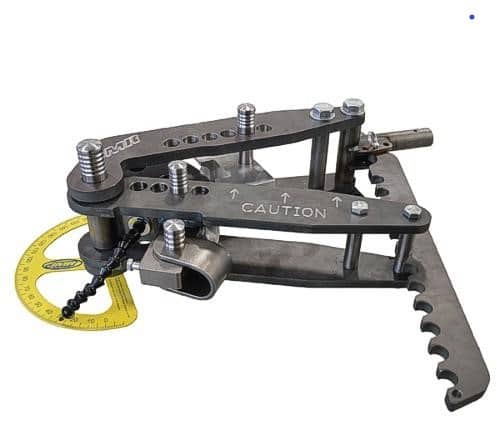
Budget horizontal arm-frame bender. Supports 2.5″ OD tube. Nylon/graphite bushings at the pivot, uncoated steel arms, heat-treated 4140 pins. Hydraulic upgrade available. Handle and stand sold separately. Floor anchoring required.
This machine is what it is: a starting point for someone who needs to make bends without a large investment and is not doing high-volume or critical structural work. Build quality reflects the price.
Woodward Fab WFB2
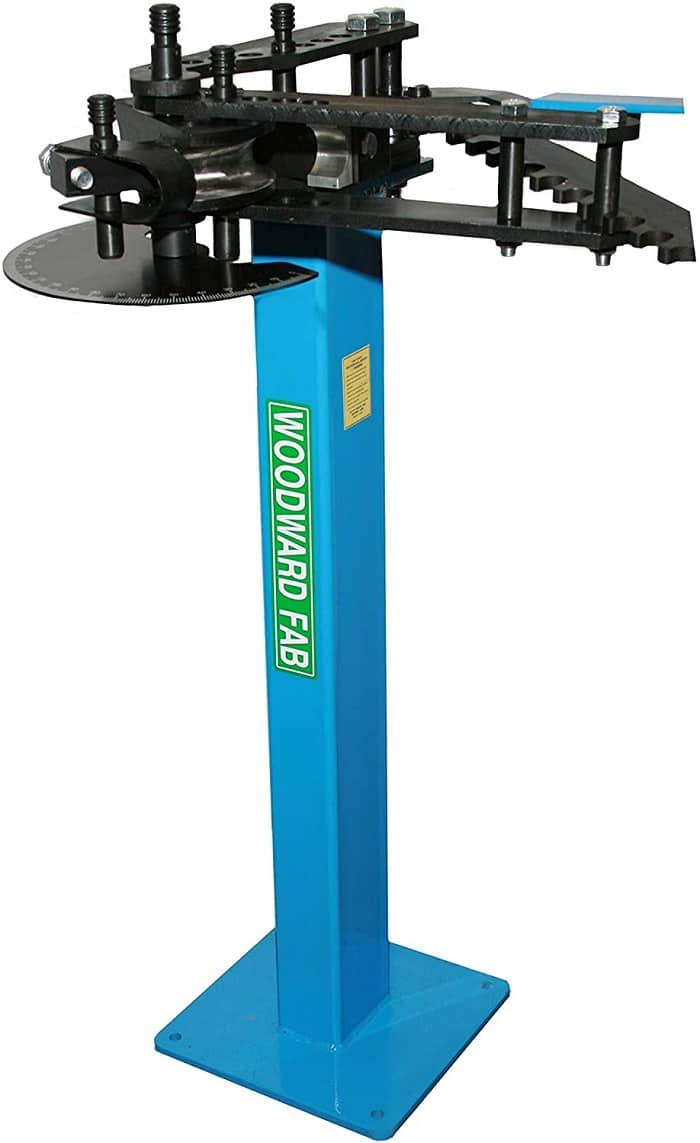
The lowest-cost machine on this list in its basic configuration. Under $350 in most current listings. Bends up to 2″ OD. CNC-machined components, engraved degree dial on the machine. 27-29 inch handle depending on the version, shorter than the JD2’s 36-inch handle, which matters on heavy material. Maximum bend angle limited to 120 degrees on many dies, not 180. Stand sold separately. Floor anchoring required.
Functional for light-duty and DIY work within its capacity limits. Not a production machine.
Eastwood and similar
Several brands sell horizontal arm-frame benders in a similar price range to the WFB2. Build quality and die availability vary. If you are considering one of these, verify die availability for your specific tube sizes before purchasing. Some of these machines have limited die ecosystems that make sourcing non-standard sizes difficult or expensive.
Category 3: Bottle Jack and Pump Hydraulic Benders
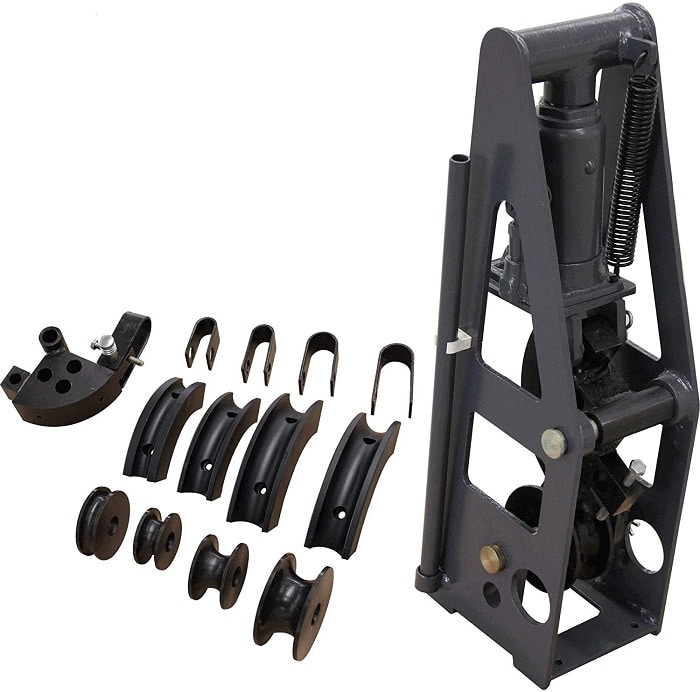
KAKA Industrial, Affordable Bender, and a range of visually similar machines sold under various brand names make up this category. The original design came from Affordable Bender and has been replicated widely. Compact frame, hand-pumped 8-ton bottle jack actuation, cast aluminum dies. Prices typically run $200-400.
These machines have real limitations that matter for anyone doing structural work:
- Maximum bend angle is approximately 90 degrees, not 180.
- Degree accuracy varies.
- Cast aluminum dies limit the precision and surface quality of the bend.
- Die availability is limited. Non-standard sizes may not exist.
- The “hydraulic” description refers to a hand-pumped bottle jack. Manual effort is still required, just assisted.
KAKA is manufactured in China, confirmed in customer reviews on their own product pages. Other brands in this category do not always publicly disclose manufacturing origin.
These machines work for what they are: occasional-use, simple bends, under 90 degrees, on a tight budget. If your work stays within those parameters, they are a functional solution. If you need bends beyond 90 degrees, consistent accuracy, or production throughput, they are not the right tool.
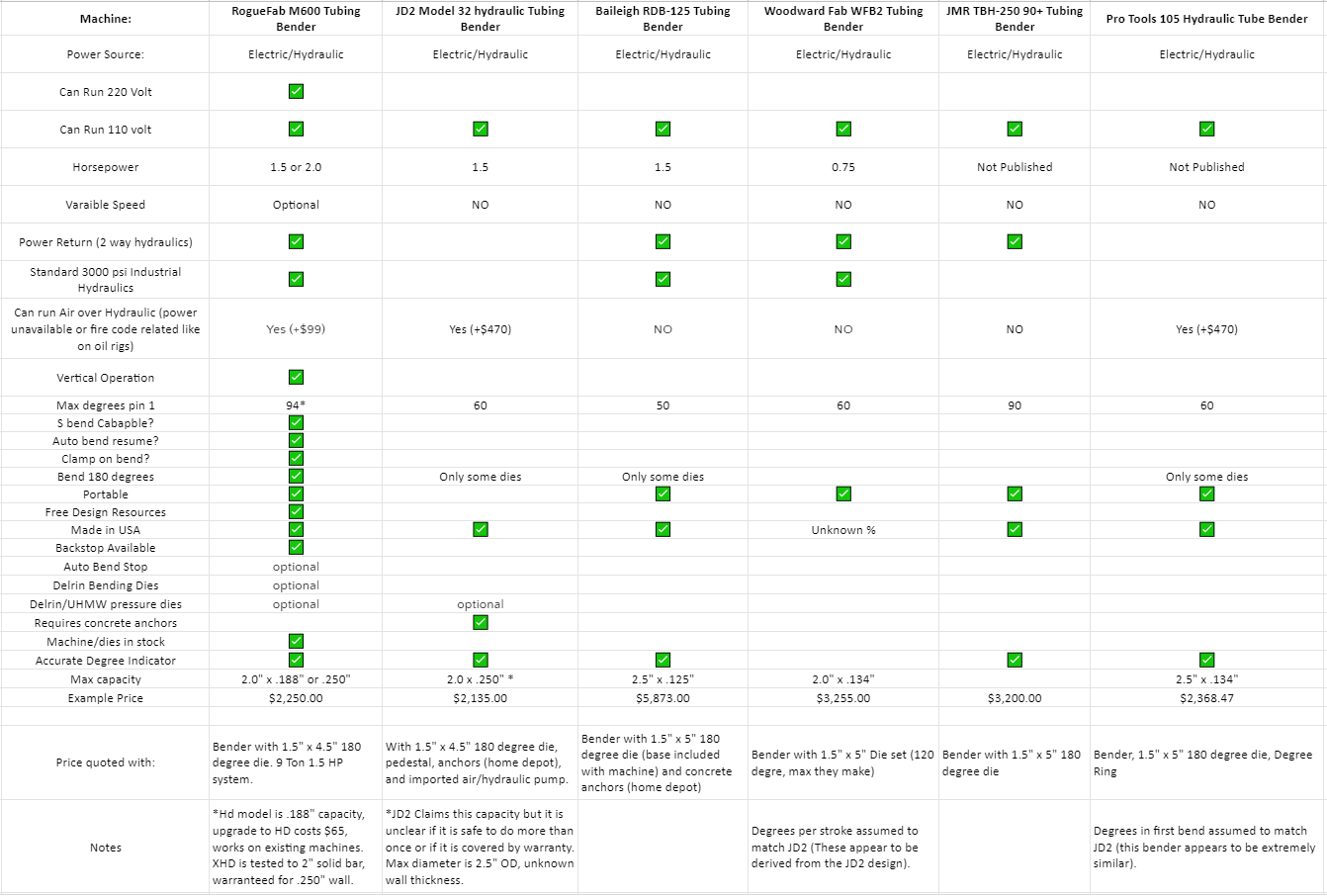
Comparison Charts
Manual and Air/Hydraulic
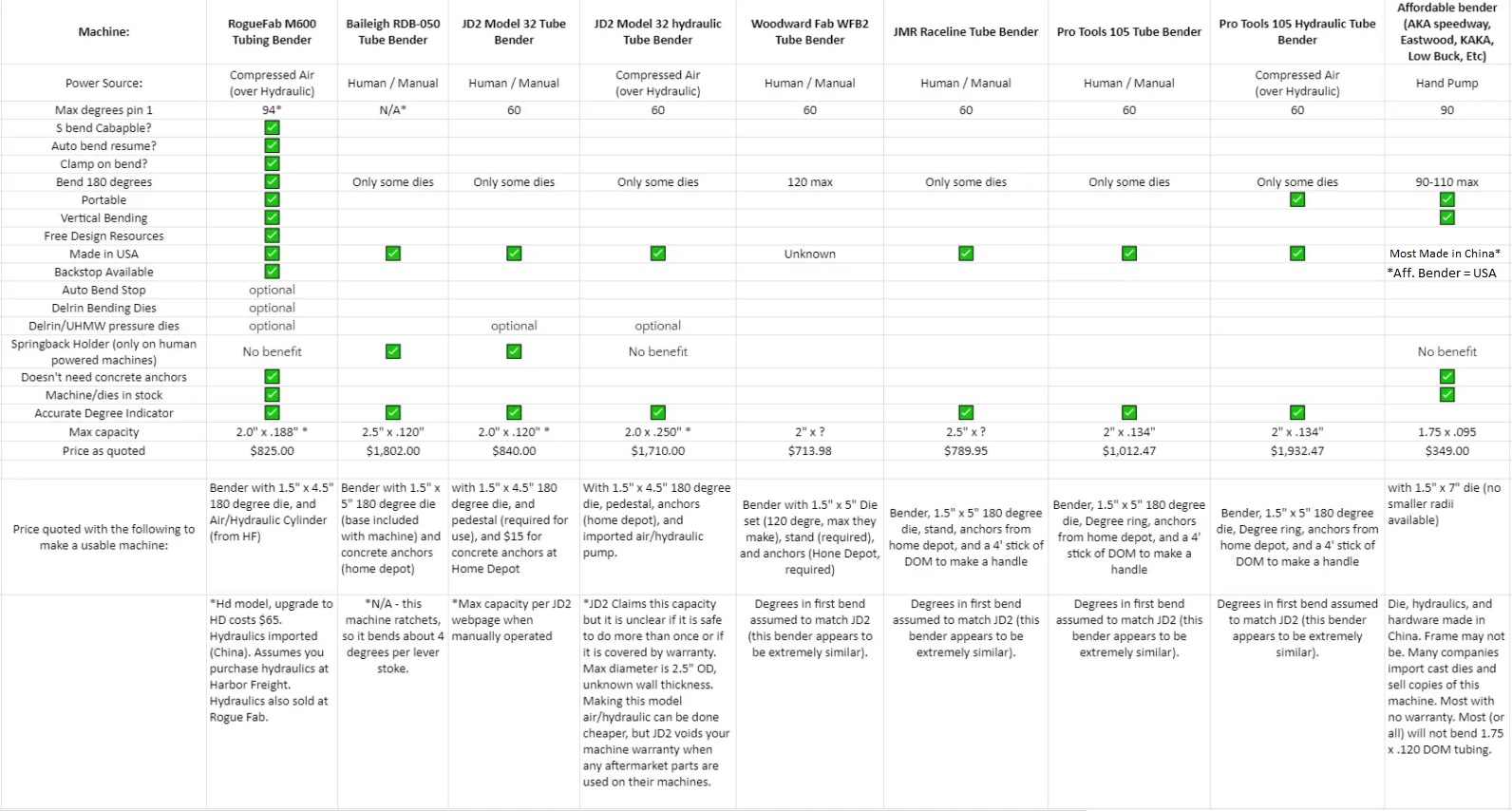
Electric Hydraulic
Which Machine for Which Application
Roll cage, chassis, and structural fabrication
M6xx M601 for most work through 1-3/4″ tube. M605 or M625 for 2″ tube and heavy material. The vertical architecture, the upgrade path, the die ecosystem, and the mandrel option all matter for this application. JD2 and Pro-Tools are functional alternatives if floor anchoring is acceptable and the upgrade path is not needed.
Exhaust and performance tubing
Depends on wall thickness and bend radius. Standard rotary draw bending on the M6xx handles most performance exhaust work. Thin-wall intercooler piping and tight-radius exhaust work benefit from the mandrel attachment. Ram benders are not appropriate for performance exhaust.
General shop and hobbyist use
JD2 Model 32 or Pro-Tools 105 if floor anchoring is acceptable. Woodward Fab WFB2 if budget is the primary constraint and work stays within 120-degree bends. Bottle jack benders for simple occasional bends under 90 degrees. M601 if you want a machine that grows with the work and does not require floor anchoring.
Production shop taking outside work
M6xx with electric hydraulic option and backstop. The auto bend stops, the double-acting hydraulics, and the mandrel option are what separate production capability from shop-grade capability. No horizontal arm-frame machine offers this combination from the original manufacturer.
Where to Go From Here
If the M6xx is the right machine for your work, the place to start is the product page. It covers capacity, die options, hydraulic options, and packages in detail. If you are not sure which model fits your tube size and wall thickness, call us. We bend tube for a living and we can tell you exactly where the capacity limits are for your specific application before you order.
M605 Tube Bender, up to 2″ tube
M625 Tube Bender, extreme heavy duty
Bender Packages
Mandrel Bender Packages
Questions: call us at 503-389-5413 or email [email protected]. We answer the phone.