Exhaust Pipe Benders: Which One Actually Fits Your Work
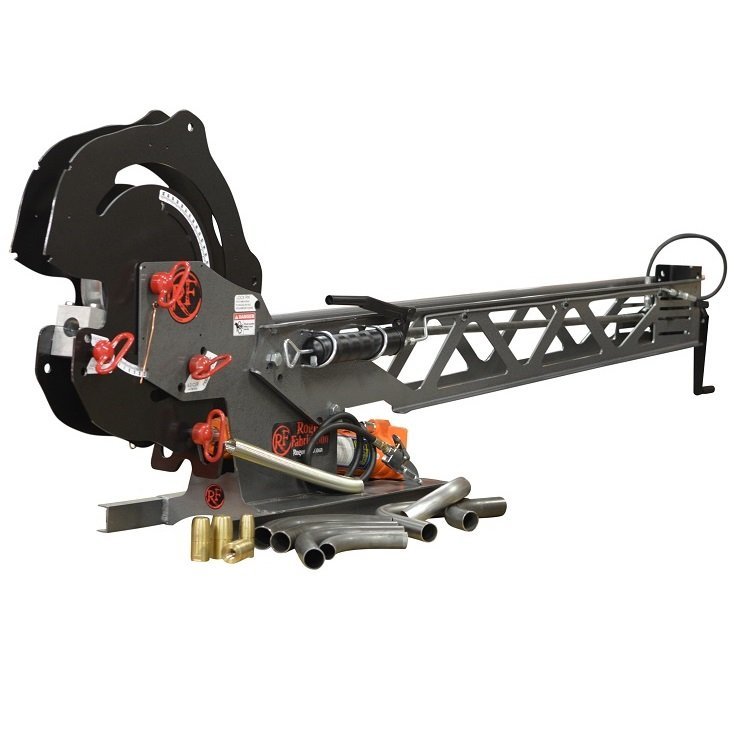
There are three distinct types of exhaust bending customer and three different right answers for tooling. This article covers all three honestly, explains the material thermal conductivity numbers that settle the stainless vs mild steel exhaust debate, and covers the bending considerations that are specific to exhaust work. If you are trying to decide whether the M6xx is the right machine for your exhaust application, this article will give you a straight answer.
Three Customer Types, Three Different Right Answers
The muffler and repair shop
Ram compression benders are the industry standard in muffler shops and exhaust repair operations. They work by pressing a die into the pipe from the outside while two support shoes hold the back side. The process is fast to set up, requires minimal tooling investment relative to volume, and produces acceptable results for thick-walled OEM-style pipe and standard repair work. The tradeoff is cross-section deformation at the bend: the pipe flattens and the inside wrinkles. For OEM exhaust replacement work, that is generally acceptable. Fully tooled professional ram bender setups start around $5,000. This is not what RogueFab builds. If your primary work is exhaust repair and you need a machine that runs all day on a mix of pipe sizes and wall thicknesses, a ram bender is probably the right answer.
The home shop single-project builder
Someone building a custom exhaust for one car or truck project often asks whether a mandrel bender is worth it. The honest answer is usually no, not for a single project with a budget constraint. A proper mandrel setup on the M6xx requires the mandrel attachment and a full tooling set for each tube diameter. That puts the entry cost at roughly $3,000 for one diameter setup. The next nearest alternative with real metallic mandrels is $60,000 or more without tooling. For a single garage project where you need clean bends in mild steel exhaust tube, non-mandrel bending on the M6xx with the Thin Wall Roller pressure die produces good results. You can also combine shop-bent sections with purchased pre-bent bends to minimize pie-cutting on complex geometry. Do not buy a mandrel setup for one car project. Buy it when the work justifies it.
The professional fabricator
Motorcycle builders, aircraft exhaust fabricators, turbo manifold builders, and shops that quote custom exhaust work regularly are the M6xx mandrel customer. The value proposition is straightforward: $2,500 to entry versus $60,000 or more for the next nearest professional-grade mandrel option. The M6xx mandrel uses bronze mandrels, the industry standard material for metallic mandrels. It produces the cross-section consistency that professional exhaust work demands. If you are bidding custom exhaust, headers, or manifolds regularly, the mandrel attachment pays for itself on the third or fourth job depending on your billing rate.
For a full technical overview of mandrel bending, including D/R ratios, bullet vs ball mandrel, and wiper dies, see the mandrel bending article.
Stainless vs Mild Steel Exhaust: The Numbers
The question of whether stainless or mild steel is better for performance exhaust comes up constantly and generates a lot of strong opinions without much data. Here are the actual thermal conductivity numbers, which end the debate.
Thermal conductivity measures how quickly a material conducts heat away from a heat source. In an exhaust system, a lower conductivity means the pipe wall retains more heat inside the pipe rather than transferring it to surrounding components and the atmosphere. Higher exhaust gas temperature means higher gas velocity, which is relevant to exhaust scavenging and performance on naturally aspirated engines.
- Mild steel (carbon steel): ~50 W/m·K. Conducts heat away from exhaust gases quickly. More heat loss through the pipe wall means cooler gas and lower downstream velocity.
- 304/316 austenitic stainless: ~16 W/m·K. Roughly three times lower thermal conductivity than mild steel. Retains heat in the pipe significantly better. Higher exhaust gas temperature and velocity downstream. The correct material choice when exhaust scavenging and gas velocity matter for performance.
- 409/430 ferritic stainless: ~25 W/m·K. Between mild steel and 304. What most OEM exhaust systems use. Better heat dissipation than 304, which protects surrounding components and reduces underhood temperatures. Better corrosion resistance than mild steel. The practical choice for daily-driven vehicles where longevity and component protection matter more than outright exhaust velocity.
- Titanium: ~22 W/m·K. Similar conductivity to ferritic stainless. Exceptional strength-to-weight ratio. Corrosion-proof. The premium material choice for weight-critical performance applications, particularly in motorsports where weight reduction at every point matters. The M6xx with the mandrel attachment handles titanium exhaust work.
The bottom line: if the goal is retaining exhaust heat for performance, 304 stainless is the correct material choice by a significant margin over mild steel. The physics says so and the numbers are citable. Ceramic coatings on mild steel pipe change the equation by reducing heat transfer through the pipe wall, which is why coated mild steel headers are common in applications where stainless cost is not justified. Both approaches work. The numbers above tell you what you are working with in each case.
Bending Notes Specific to Exhaust Work
Thin wall is the norm
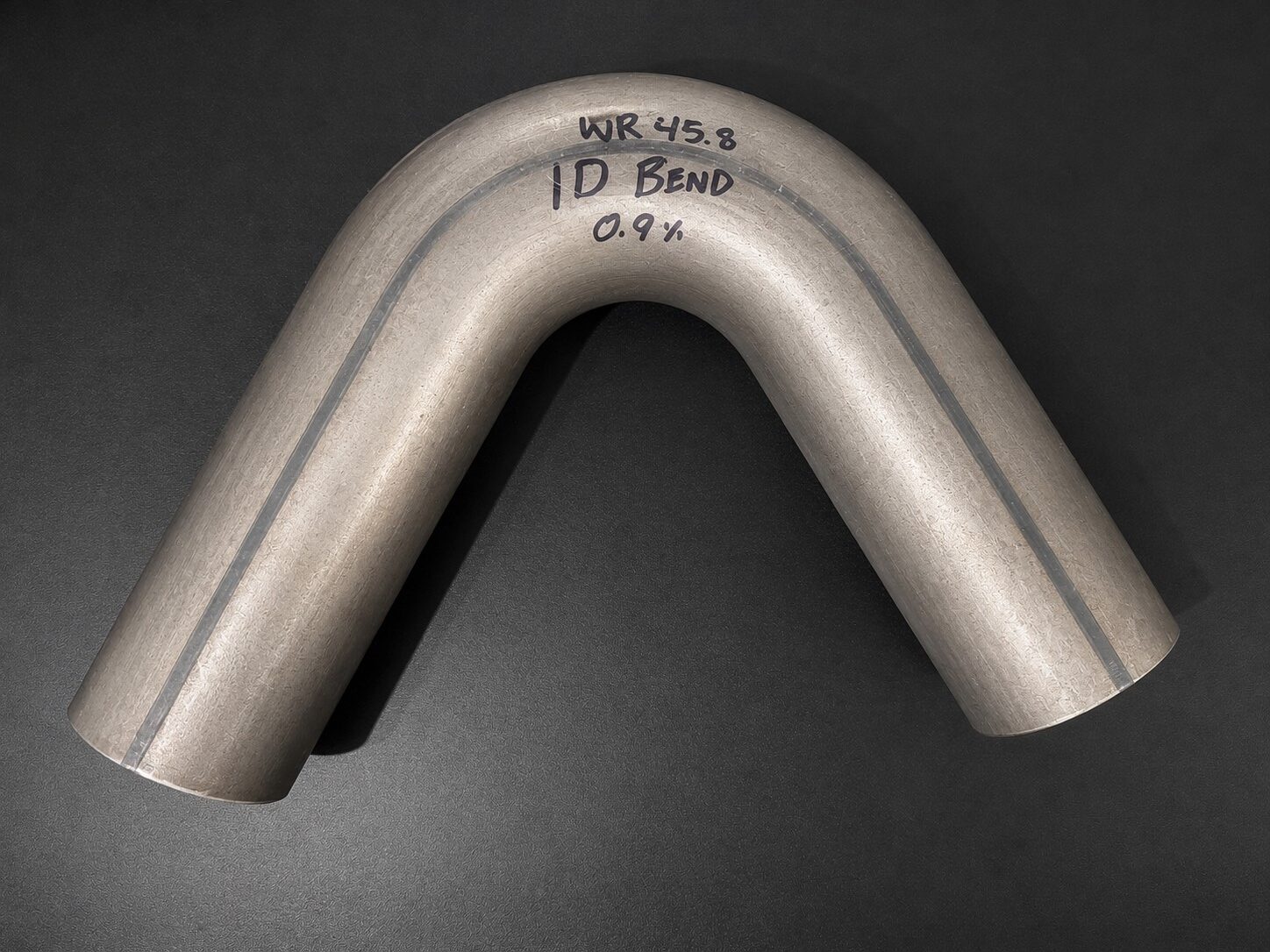
Exhaust tube is thin-wall material. Performance exhaust in 304 stainless typically runs .065″ wall or lighter. Thin wall means high wall ratio, which means more deformation risk at a given CLR. The combination of thin wall and the tight radii required by engine bay geometry is where standard rotary draw bending reaches its limits and mandrel bending becomes necessary. A 2.5″ OD x .065″ wall 304 stainless tube on a 3.5″ CLR die is a demanding bend that requires a mandrel to produce clean results. The same tube in .120″ wall bends significantly more cleanly without a mandrel.
Mild steel exhaust
Standard mild steel exhaust tube in .083″ or heavier wall bends cleanly on the M6xx without the mandrel attachment for most exhaust applications. The Thin Wall Roller pressure die improves results on the thinner end of that range. For headers and tight-radius work in mild steel, the mandrel attachment produces noticeably better results and is worth using if you already own it. For general exhaust runs in moderate wall material, non-mandrel bending is sufficient.
304 stainless exhaust
Stainless work hardens during bending, which makes thin-wall stainless exhaust more demanding than the same diameter in mild steel. The wrinkling failure mode covered in the stainless bending article is most likely to occur on thin-wall stainless at tight radii. Use the largest CLR die the geometry allows, confirm your wall ratio is within range on the capacity chart, and use the mandrel attachment for anything with a wall ratio above 20 or a D/R below 3.0, and consider it seriously for D/R ratios between 2.5 and 3.0 depending on the specific material and wall thickness.
Titanium exhaust
Titanium exhaust bending requires careful technique, appropriate CLR selection, and mandrel use on thin-wall material. The M6xx handles titanium with the mandrel attachment. For material and process notes specific to titanium, see the titanium bending article.
Turbo manifolds and downpipes
Turbo manifold fabrication involves tight radii, multiple bends in confined spaces, and 304 stainless thin-wall material. Mandrel bending is standard for quality manifold work. The alternative is pie cutting: cutting and welding sections of bent tube to achieve geometry that a bender cannot reach. Pie cutting is a valid technique and produces excellent results in experienced hands, but every additional weld is a potential failure point in a high-heat application. Minimizing pie cuts with mandrel-bent sections produces a cleaner, stronger result. The M6xx mandrel handles the tube sizes used in most turbo manifold work, including the 2.0″ and larger OD sizes common with larger turbos.
Motorcycle exhaust
Motorcycle exhaust fabrication involves small-diameter tube, typically 1.25″ to 1.75″ OD, in 304 stainless or titanium, with tight radii and complex routing through tight spaces. The M6xx mandrel handles these sizes cleanly. Motorcycle builders are some of the most quality-conscious exhaust fabricators in the market. The exhaust is visible and the customer is paying attention to the quality of every bend.
Aircraft exhaust
Aircraft exhaust systems use thin-wall 304 or titanium in small to mid-range diameters with demanding quality standards. Mandrel bending is standard. The M6xx with the mandrel attachment produces bends that meet the dimensional requirements for aircraft exhaust work. Certification documentation is the fabricator’s responsibility.
Die Selection for Exhaust Work
Exhaust work covers a range of tube diameters. The most common sizes in automotive performance exhaust are 2.0″, 2.25″, 2.5″, and 3.0″ OD. In motorcycle exhaust, 1.25″ to 1.75″ OD. For most of these sizes, use the largest CLR die that the chassis geometry allows. The 6.0″ CLR die produces the cleanest bends with the least deformation across the size range. Tighter CLR dies are sometimes required by routing constraints in tight engine bays, but go as large as the geometry permits.
For the full capacity range by tube size and wall thickness across all three M6xx models, use the Bender Capacity Chart. It covers every die size in the ecosystem and shows exactly where each model’s capacity limits are.
M6xx for Exhaust Fabrication
The M601 covers the full range of exhaust tube sizes used in motorcycle, automotive, and most aircraft exhaust applications: 1/2″ through 1-3/4″ OD. The M605 extends to 2.0″ OD for larger automotive and diesel exhaust, turbo manifold work, and the 2.25″ OD size common with larger turbo flanges. Both machines accept the mandrel attachment and share the same die ecosystem.
For shops doing regular exhaust work, the mandrel attachment on the M6xx is the most cost-effective path to professional-grade mandrel bending capability in this market. The gap between the M6xx mandrel entry cost and the next professional alternative is not close. If exhaust is part of your shop’s regular work, the machine pays for itself quickly.
M605 Tube Bender, up to 2″ tube
Mandrel Bender Packages
Mandrel Attachment for existing M6xx
All M6xx Tube Benders
Questions about whether the M6xx handles your specific exhaust application, tube size, and wall thickness: call us at 503-389-5413 or email [email protected]. We answer the phone.