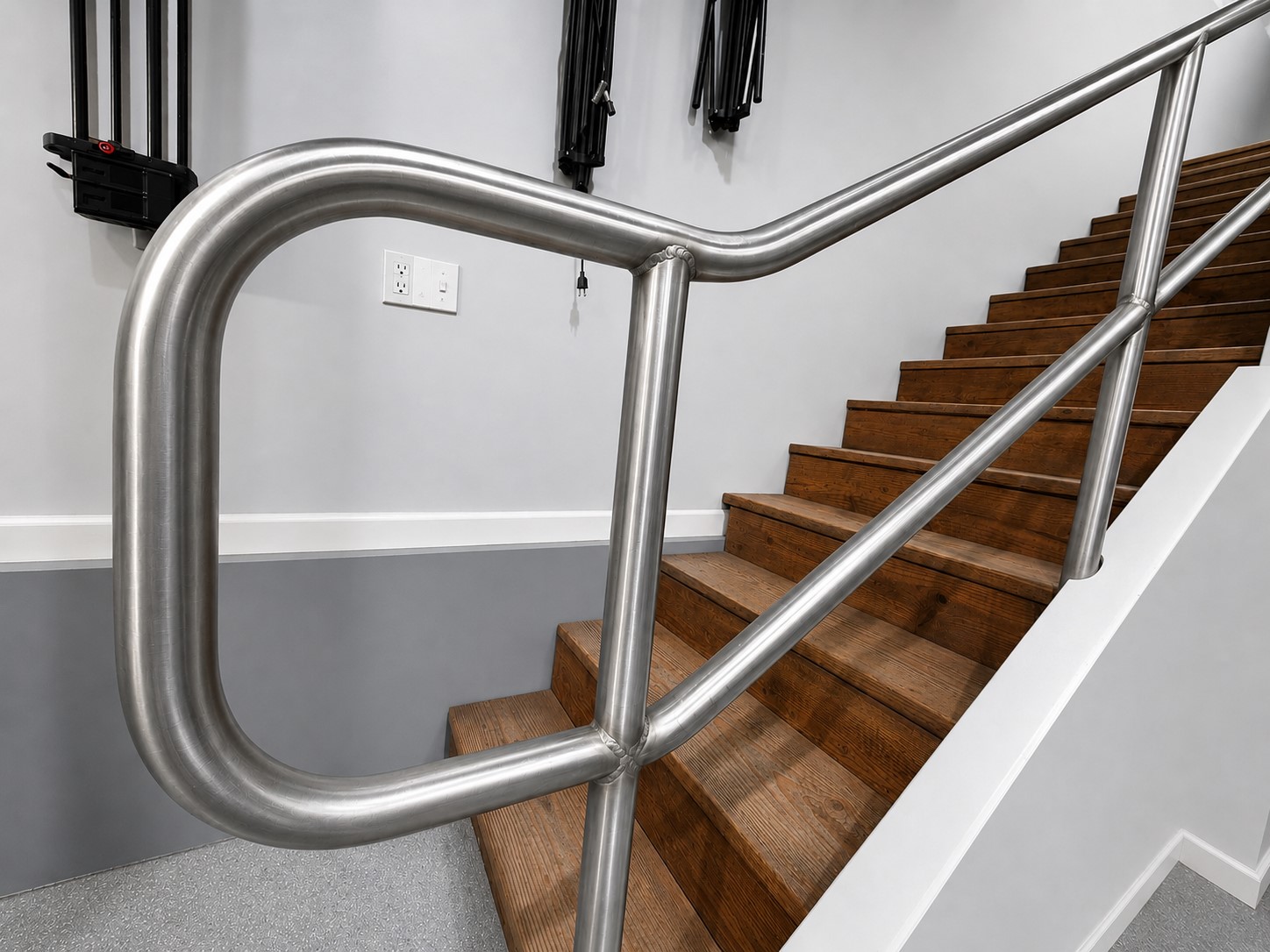
Bending Stainless Steel Tube: What the Material Actually Demands
Stainless steel is not a difficult material to bend if you understand what it is doing during the bend. It is a demanding material if you treat it the same way you treat mild steel. This article covers the mechanism behind the most common stainless bending failures, the alloy and tooling decisions that prevent them, and the notching rules that save hole saws. The audience is fabricators who already bend tube and want to do it correctly in stainless.
Why Stainless Wrinkles: The Mechanism
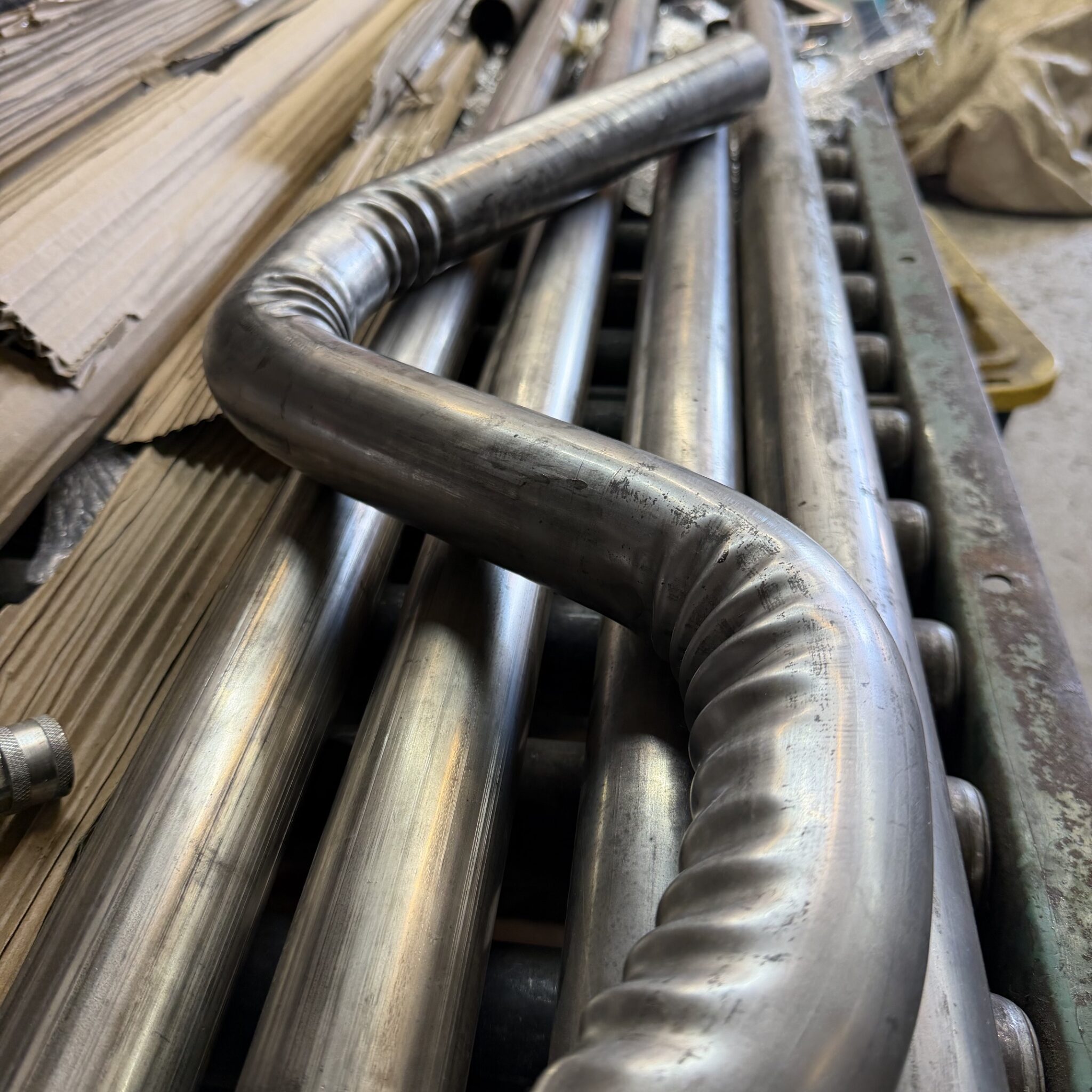
Austenitic stainless steel, which covers 304, 304L, 316, and 316L, work hardens rapidly during bending. On the outside of the bend, the material stretches and work hardens as the bend forms, building resistance to further deformation. On the inside of the bend, the material is in compression. When the wall is thin relative to the bend radius, the inside wall runs out of compressive capacity and buckles inward before the geometry can absorb the strain. That buckling is a wrinkle, and once it starts it does not stop.
The three variables that control whether wrinkling occurs are wall ratio, D/R ratio, and whether a mandrel is used. Wall ratio is the tube OD divided by wall thickness. A high wall ratio means a thin wall relative to tube size, which means less compressive capacity on the inside of the bend. D/R ratio is the centerline radius divided by the OD. A lower D/R means a tighter bend and more strain on both walls. When both wall ratio and D/R push toward their limits simultaneously, wrinkling is nearly certain on stainless without a mandrel.
In practical terms, stainless requires a thicker wall relative to OD than mild steel does at the same bend radius. A 1.5″ x .065″ wall stainless tube at a 3.5″ CLR is a setup for wrinkling. The same bend in .120″ wall is significantly more forgiving. When the material is thin and the radius is tight, use a mandrel. The mandrel provides internal support at exactly the point where compression is trying to buckle the wall, and it is the most direct solution to the problem.
Springback in Stainless
Stainless has more springback than mild steel and significantly more than aluminum. Plan to overbend. The exact overbend amount varies by alloy, wall thickness, and bend radius, so the correct approach is to take one or two test bends on a new material and die combination, measure the springback, and use that offset consistently for the rest of the job.
On the M6xx, the degree wheel handles this process directly. Bend to your overbend angle, release, measure the achieved angle, calculate the difference, and adjust. After two test bends on a new stainless setup you will have a reliable offset. Write it down and keep it with your die notes. Stainless springback is consistent within a lot of material from the same supplier, so the number you establish is reusable across the project.
One thing worth noting is that 316 tends to spring back slightly more than 304 due to its higher work hardening rate. The difference is small but worth accounting for if you are switching between alloys on the same die setup.
Alloy Selection
The stainless alloy you choose matters more than most fabricators realize. Here are the grades that show up most in bending work and the reasons to choose each one.
304
The most common austenitic stainless. General purpose, widely available, used in architectural railing, structural applications, food processing equipment, and performance exhaust. Machines and welds well. The default choice when no specific alloy is called out.
304L
Low-carbon version of 304. The lower carbon content reduces the risk of carbide precipitation in the heat-affected zone during welding, which can reduce corrosion resistance in standard 304. For most shop welding applications the difference is minor. For applications with extended heat exposure or aggressive corrosive environments, 304L is the correct choice.
316 and 316L
Marine grade stainless. The addition of molybdenum gives 316 superior resistance to chloride-induced corrosion, the failure mode that destroys standard 304 in saltwater environments. If the part will be on a boat, near the ocean, or in any application with regular saltwater exposure, use 316. The 316L variant carries the same low-carbon welding benefit as 304L. For marine fabrication, 316L is the correct specification.
Sanitary stainless (316L thin wall)
Food processing, pharmaceutical, and dairy applications use thin-wall 316L tube to tight dimensional tolerances. Suppliers like RathGibson produce premium sanitary stainless that meets the surface finish and dimensional requirements of FDA and 3-A sanitary standards. This material is among the most demanding to bend: thin wall, precise OD tolerances, and no tolerance for surface marks or deformation. Mandrel bending is standard for any sanitary stainless application where cross-section consistency or surface quality matters. If you are bidding sanitary fabrication work for the first time, budget time to dial in your setup on sample material before cutting production tube.
Architectural vs. structural 304
This distinction matters when you are ordering material and your supplier may not flag it automatically. Architectural or ornamental stainless tube (ASTM A554) is produced to tighter OD and roundness tolerances, with a cleaner surface finish, at a higher cost. Structural 304 has looser tolerances and is cheaper. Both bend on the M6xx. The difference shows up when you are bending pre-polished architectural tube and need the die contact to leave no marks, and when you are fitting ornamental work where slightly out-of-round tube causes fitup problems. Know which one you are buying. Your steel supplier can confirm the spec.
Tooling Choices for Stainless
Standard billet dies
Standard billet aluminum dies work for structural stainless bending where surface marks are acceptable and the material will be welded rather than displayed. The dies are harder than the tube groove contact surface needs to be, but the marking is minor on unprepared stainless and disappears in the weld prep process.
Steel-reinforced Delrin dies for pre-polished tube
For architectural stainless and any application where the bent tube goes directly into a visible installation without refinishing, Delrin-faced dies significantly reduce contact marking. Delrin does not score the tube surface the way bare aluminum does. The steel plate backing maintains dimensional stiffness. For shops doing architectural railing in pre-polished stainless, the Delrin die upgrade pays for itself quickly in reduced re-polishing labor. The cost of the tooling upgrade is almost always less than the labor cost of polishing out contact marks on a set of finished rails.
Pressure roller die
The standard pressure die drags across the tube surface as the bend forms. On pre-polished stainless, that drag leaves a line. The pressure roller die uses rolling contact instead, applying consistent pressure without surface drag. For appearance-critical stainless work, the roller die is worth having alongside Delrin bend dies. Together they produce bends where the only finishing required is the weld area.
Mandrel for thin-wall stainless
As covered in the wrinkling section, mandrel bending is the direct solution for thin-wall stainless at tight bend radii. The M6xx mandrel attachment uses bronze mandrels, which are the industry standard mandrel material: hard enough to support the wall under bending load, soft enough not to score the tube interior. For sanitary stainless where interior surface quality matters, bronze is the correct mandrel material. Nylon and urethane mandrels compress under the load conditions that thin-wall stainless generates and are not an appropriate substitute.
Notching Stainless Steel
Notching stainless is significantly harder than notching mild steel, and the failure mode is different. In mild steel, a dull hole saw produces a slow, rough cut that you notice early. In stainless, a work-hardened surface stops the hole saw cold. The teeth stop cutting and start rubbing, and rubbing work hardens the surface further. By the time you notice the cut has stalled, the hole saw is likely finished at that location and the surface it is trying to cut is harder than the saw.
There are three rules for notching stainless that prevent this outcome.
Low RPM
High RPM generates heat and work hardens the cut surface faster. For stainless with a bimetal hole saw in a tube notcher, keep the RPM low. The cut takes longer but the saw stays in the cutting regime rather than the rubbing regime. Specific RPM depends on the hole saw diameter and the notcher’s drive, but as a general rule: if the saw is getting hot to the touch quickly, slow down.
Keep cutting continuously
Stopping in the middle of a cut on stainless is one of the fastest ways to ruin a hole saw. When the teeth stop advancing and start scrubbing, work hardening begins immediately. If you need to stop, withdraw the saw completely, clear the chips, reapply lubricant, and re-enter at a fresh angle if possible. Never allow the saw to spin in contact with the work without advancing.
Use the right lubricant
Light cutting oil is not enough for stainless. Use a heavy paste lubricant that stays in the cut zone. Anchorlube is the industry standard for stainless tube notching: it has the viscosity to stay at the cut rather than running off, it reduces heat effectively, and it extends hole saw life significantly compared to light oil or no lubricant. A can of Anchorlube is cheap. Hole saws are not.
When the cut has already work-hardened
If a cut has stalled and work-hardened the surface, do not try to continue with a fresh hole saw. A new saw will fail on a work-hardened surface almost immediately. The correct recovery is abrasive: a cutoff wheel and grinder to remove the hardened material and get back to fresh metal. This is one of the few cases where finishing with a grinder is actually the right answer rather than a sign that something went wrong with the notcher setup.
A Note on Welding Stainless
TIG welding stainless uses DCEN (direct current electrode negative). Not AC. AC is the correct polarity for aluminum. Using AC on stainless produces an erratic arc and poor weld quality. If you have set up for aluminum and switched to stainless without changing polarity, that is the first thing to check.
Back purging, the process of filling the inside of the tube with argon shielding gas during welding, is required for many stainless applications to prevent oxidation on the inside of the weld. The oxidation produces a sugared appearance on the inside of the weld bead that indicates incomplete shielding and reduced corrosion resistance. For structural stainless where the inside of the weld is never inspected or exposed to a corrosive environment, back purging is sometimes omitted. For sanitary stainless, marine applications, and any specification that requires a clean inside weld surface, back purge.
Common Stainless Bending Applications
Marine fabrication
316L is the standard for marine railing, pulpit frames, stern railings, and any structural tube on a vessel with saltwater exposure. The bend geometry is similar to aluminum marine work, with moderate radius bends, but 6063 alloy is replaced by 316L stainless and the weight, springback, and tooling considerations are different. Use the correct CLR die for the tube size, confirm your mandrel setup for any thin-wall work, and plan for the extra springback compared to mild steel.
Architectural and commercial railing
304 architectural tube (ASTM A554) in satin or mirror finish is the standard for commercial stainless railings. Pre-polished material requires Delrin or UHMW dies and the pressure roller die to protect the surface. The bend quality and surface preservation requirements here are stricter than structural work. Test your setup on a sample length before running production material.
Performance exhaust
304 stainless is the standard material for performance exhaust systems. Thin-wall, tight radius, and appearance matters. Mandrel bending is the norm for quality exhaust work. The cross-section of a mandrel-bent exhaust tube is round through the bend; a standard-bent thin-wall exhaust tube flattens noticeably at the midpoint of the bend, which restricts flow and looks wrong at the coupling. For headers and tight-radius exhaust bends in thin-wall 304, the mandrel attachment is not optional.
Food processing and pharmaceutical
Sanitary stainless applications use 316L thin-wall tube to tight tolerances. The fabricator working in this space is dealing with demanding material, strict surface requirements, and customers who inspect welds and bends closely. Mandrel bending, bronze mandrels, and careful setup are the standard. RathGibson is one of the primary suppliers of premium sanitary stainless tubing in this market, and their material is worth specifying when dimensional consistency and surface quality are critical.
The M6xx for Stainless Steel Bending
The M6xx bends stainless across the full capacity range of each model. The same die ecosystem that covers mild steel and chromoly covers stainless: 50+ die sizes, 2.5″ through 6.0″ CLR, 1/2″ through 2.0″ OD. The mandrel attachment is available for thin-wall applications. The Delrin die and pressure roller options are available for pre-polished architectural and marine stainless.
For most stainless bending work, the M601 is the right machine through 1-3/4″ OD. Marine railing in 316L, architectural 304, and performance exhaust all fall within M601 capacity. For 2.0″ OD stainless in heavy structural or marine applications, the M605 adds that capacity with the same die ecosystem and upgrade path.
M605 Tube Bender, up to 2″ tube
Mandrel Bender Packages
Mandrel Attachment for existing M6xx
Tube Notchers
Questions about stainless capacity, die selection, or mandrel setup for a specific application: call us at 503-389-5413 or email [email protected]. We answer the phone.