What Is Tube Bending? A Plain-English Introduction
Tube bending is exactly what it sounds like: bending metal tube into a shape. But there is more to it than that, and understanding the basics before you buy a machine or start a project saves a lot of wasted material and frustration. This article covers the fundamentals: tube vs. pipe, how rotary draw bending works, what the common terms mean, why bend quality matters, and where to go when you are ready to go deeper.
Tube vs. Pipe: Start Here
The most common mistake beginners make is using the words tube and pipe interchangeably. They are not the same thing, and that distinction matters when you are buying material or ordering tooling.
Tube is a structural member, specified by outside diameter (OD) and wall thickness. When you order 1.75″ x .120″ wall DOM tube, you get a tube with a 1.750″ outside diameter and a .120″ wall. The dimensions are what they say they are.
Pipe, on the other hand, is a pressure vessel specified by a nominal pipe size (NPS) that does not match its actual dimensions. A 1″ pipe does not have a 1″ outside diameter. The nominal size refers to a historical bore dimension standardized before modern manufacturing. The actual OD of 1″ schedule 40 pipe is 1.315″, and wall thickness varies by schedule. If you try to order tube bending tooling using the nominal pipe size, you will get the wrong tooling.
For tube bending work, buy tube rather than pipe unless the application specifically calls for pipe. Structural tube is stronger, lighter, and dimensionally consistent in a way that pipe is not. The one common exception is aluminum pipe for marine and architectural railing work, where 1-1/4″ and 1-1/2″ schedule 40 aluminum pipe is the industry standard. In that case, use the actual OD (1.66″ for 1-1/4″ pipe, 1.90″ for 1-1/2″ pipe) when selecting your die.
How Rotary Draw Bending Works
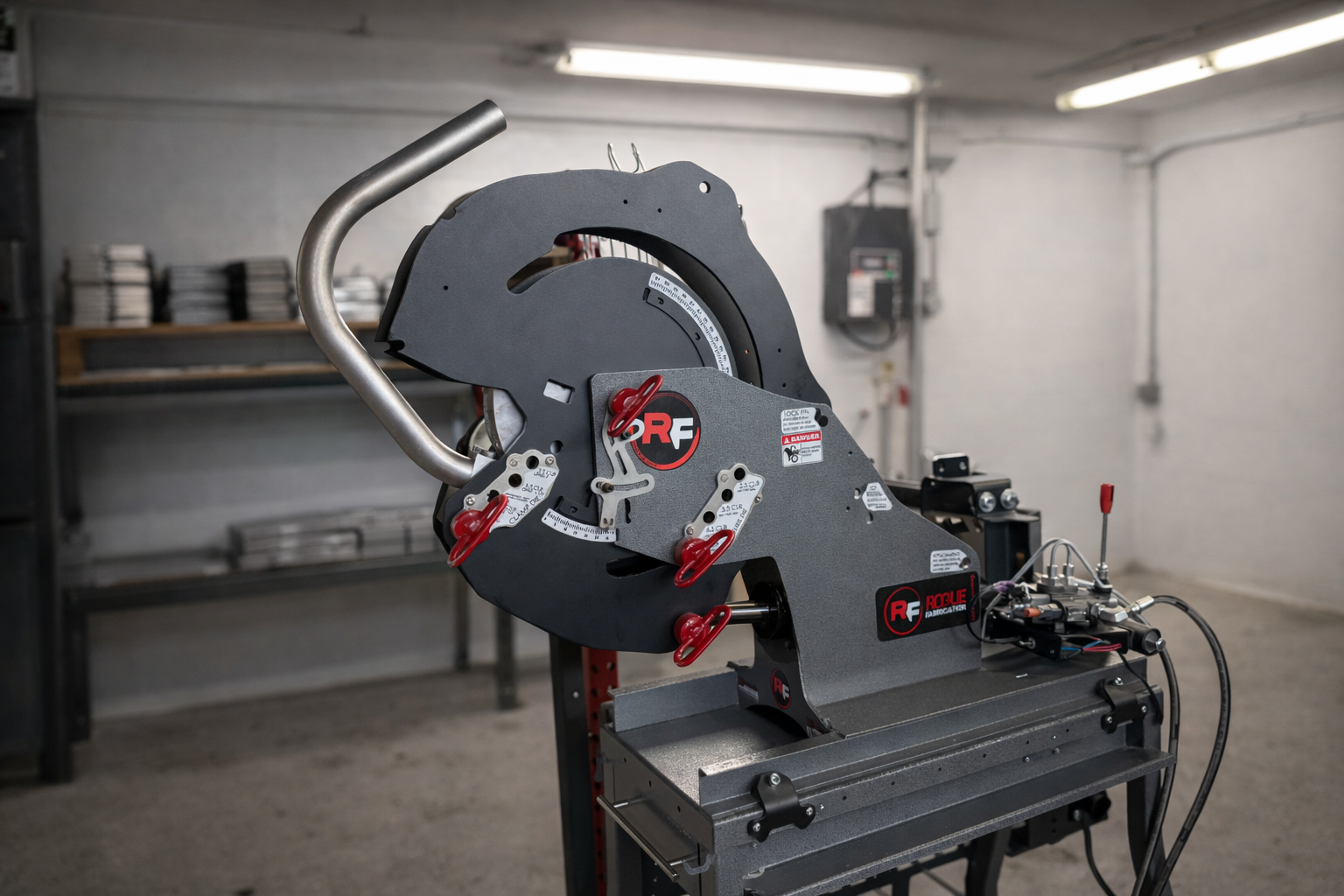
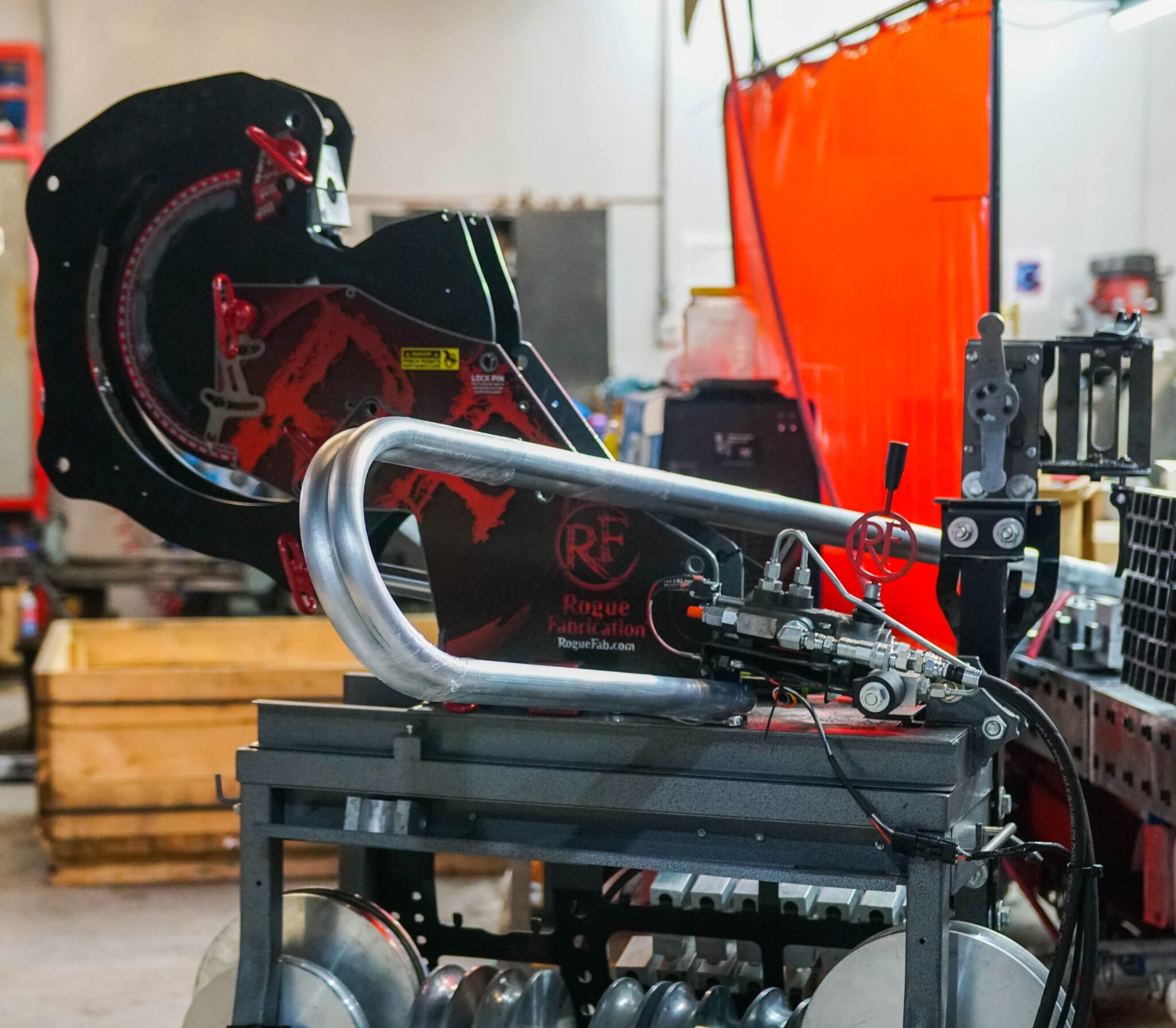
Rotary draw bending is the standard method for structural fabrication work. It is what the M6xx does, and what most tube benders used for roll cages, bumpers, exhaust, and chassis work do. Here is how it works in plain English.
A bend die is a round die with a groove machined to match the tube OD, and it is the die that determines the radius of the bend. A clamp die holds the tube against the bend die at the start of the bend, while a pressure die presses the tube against the bend die on the trailing side as the bend die rotates. When the machine operates, the bend die rotates and draws the tube around it, bending the tube to the radius of the die. The result is a clean, consistent bend with defined geometry.
The key word is draw: rather than crushing or pressing the tube from the outside, the machine draws the tube around the form. That is what produces a clean, round cross-section instead of the flat, deformed bends you get from ram benders and compression benders.
For a complete overview of options on the M6xx and how the machine works in practice, this video covers it well:
Key Terms You Will Encounter
Outside Diameter (OD)
The diameter of the tube measured across the outside. This is the number you use to select dies. A 1.75″ tube needs a 1.75″ die.
Wall thickness
The thickness of the tube wall, measured in inches or millimeters. A .120″ wall is a common structural thickness for cage and chassis work, while thinner walls show up in exhaust and weight-sensitive applications, and thicker walls in heavy structural work. Beyond just sizing, wall thickness determines how much material is available to stretch and compress during the bend, which directly affects how tight a radius you can achieve and whether you need a mandrel.
Centerline Radius (CLR)
The radius of the bend, measured to the centerline of the tube, and the number stamped on your die. A 6.0″ CLR die produces a bend where the center of the tube traces an arc with a 6-inch radius. A tighter (smaller) CLR produces a sharper bend, while a looser (larger) CLR produces a sweeping one. For most structural work, use the largest CLR die that fits the geometry of the part, since larger radius bends produce less wall thinning, less ovality, and cleaner results overall.
For a deeper look at CLR, die selection, and bending geometry, the Bender Tech page covers it in full.
D/R ratio
The centerline radius divided by the tube OD. A 6.0″ CLR die on 1.75″ OD tube gives a D/R of 3.43, while a 3.5″ CLR die on the same tube gives 2.0. Lower D/R ratios mean tighter bends and more stress on the material, and below about 3.0D, mandrel bending becomes worth considering for thin-wall tube.
Springback
After the tube is bent and the machine releases pressure, the tube springs back slightly toward its original shape as the elastic portion of the deformation recovers. Every material springs back a different amount, so to compensate, you overbend past the target angle and let springback bring the tube to the correct position. The amount of overbend needed is called the springback compensation, and it varies by material, wall thickness, and bend radius. Measure it once per material and die combination and use that number consistently.
Ovality
When a tube bends, the cross-section at the midpoint deforms slightly from round to oval: the outside stretches and flattens while the inside compresses and can wrinkle. Ovality is the difference between the widest and narrowest OD at the bend midpoint, expressed as a percentage of the nominal OD. Below 8% is the target for most structural work, since higher ovality reduces the tube’s load-carrying capacity at the bend. Use the bend quality calculator to predict ovality for your specific tube and die combination before you bend.
Wall thinning
The outside of the bend stretches during bending, thinning the wall. How much it thins depends on the D/R ratio and the wall ratio (OD divided by wall thickness), with high wall ratios and tight D/R ratios producing the most thinning. For structural applications, the thinned wall at the bend is accounted for in the design. For pressure applications like hydraulic lines, though, wall thinning needs to be calculated and verified against the required minimum wall.
Weld seam orientation
ERW (electric resistance welded) tube has a seam along its length where the tube was welded closed during manufacturing. DOM tube (drawn over mandrel) also starts as welded tube, but the drawing process works the weld and produces a much less distinct seam. For most structural work, seam position does not significantly affect bend quality. For appearance-critical work, however, orienting the seam to the neutral axis of the bend, meaning the side rather than the inside or outside, keeps it out of the highest-stress zone.
Why Bend Quality Matters
A bad bend is not just ugly. It is weaker, harder to notch, and harder to fit up for welding. On a roll cage, a bend with 15% ovality has meaningfully less section modulus than straight tube of the same material. On an exhaust system, a flattened bend restricts flow, and on an intercooler pipe, an out-of-round bend does not seal properly at the coupler.
The variables that determine bend quality are die selection, machine setup, material, and technique. Get these right and bends come out clean and consistent. Get them wrong, and you waste material and time chasing problems that were entirely predictable before you started.
The bend quality calculator lets you calculate expected ovality and wall thinning for any tube size, wall thickness, and CLR before you bend. It takes two minutes, eliminates a lot of guesswork, and is worth running any time you are selecting dies for a new application.
Common Materials for Tube Bending
The M6xx bends all of these. Here is a one-line summary of each:
- DOM 1020/1026 mild steel: The standard for roll cages, bumpers, chassis, and structural work. Welds easily, bends predictably, widely available. Start here if you are new to tube bending.
- 4130 Chromoly: Stronger than DOM for the same wall thickness, requires TIG welding, springs back more. Used in high-performance cage and chassis work where weight matters.
- Aluminum 6061-T6 and 6063: Lightweight, corrosion-resistant, used in marine railing, wake towers, intercooler piping, and architectural applications. More surface-sensitive than steel. See the aluminum bending article for full coverage.
- Stainless steel: Corrosion-resistant, harder to bend than mild steel, requires more bending force. Used in food service, marine, and architectural applications where finish matters. See the stainless bending article for details.
- Titanium: Extremely high strength-to-weight ratio, very expensive, requires careful technique and TIG welding. Used in aerospace and high-end motorsports. See the titanium bending article.
- Copper and brass: Used in plumbing, HVAC, decorative, and some industrial applications. Soft and easy to bend, low springback. See the brass and copper bending article.
What Tube Bending Is Used For
Tube bending shows up in more places than most people expect. Some of the most common applications:
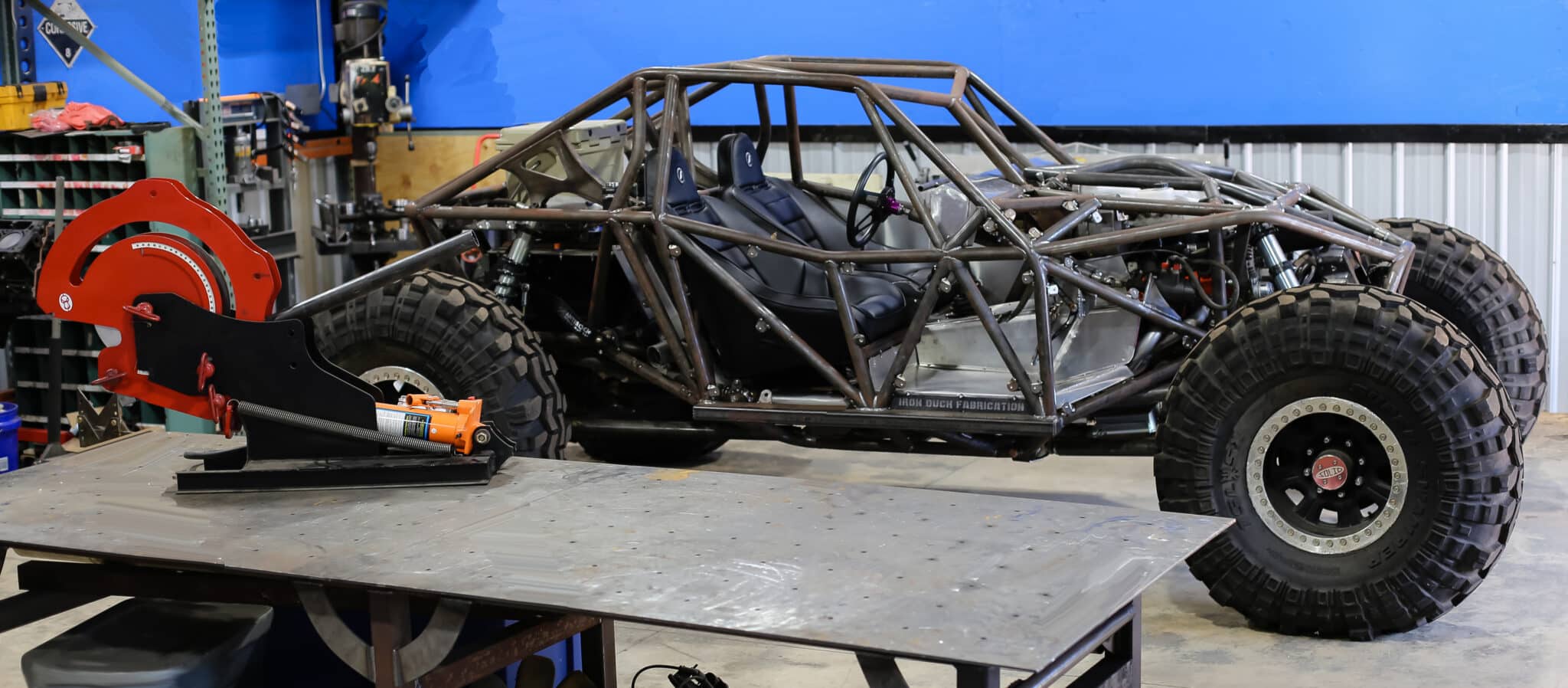
- Roll cages and exo cages: The primary safety structure in off-road vehicles, race cars, and buggies. Bent from DOM or chromoly steel. See the roll cage build guide.
- Bumpers and sliders: Front and rear bumpers, rock sliders, skid plates for trucks and off-road vehicles.
- Chassis and subframes: Tube frame vehicles, dune buggies, sand cars, custom chassis builds.
- Exhaust systems: Performance exhaust headers, turbo outlets, downpipes, exhaust bends. Thin-wall work that often benefits from mandrel bending.
- Intercooler and intake piping: Charge pipes, intercooler tubes, intake tubes in turbocharged applications. Mandrel bending is standard for this work.
- Marine railings and T-tops: Aluminum railing, wake towers, bimini tops, T-top frames. See the aluminum bending article.
- Handrails: ADA-compliant handrails, apartment railings, DOT infrastructure, commercial stair rails.
- Hydraulic and fuel lines: Bent steel or aluminum tube for fluid transfer in industrial, agricultural, and automotive applications.
- Furniture and art: Chair frames, table bases, custom furniture, architectural installations, sculptural metalwork.
Choosing a Tube Bender
Machine selection comes down to three questions: what tube size do you need to bend, how much capacity do you need, and what features matter for your specific work.
The M6xx series covers the range of tube sizes needed for the majority of structural fabrication, motorsports, and marine work. The M601 handles tube through 1-3/4″ OD, the M605 extends to 2.0″ OD for SCORE, trophy truck, and heavy structural applications, and the M625 is the extreme heavy-duty version of the same architecture. Importantly, all three share the same die ecosystem, the same cart, and the same upgrade path: over 50 die sizes, all compatible across all three machines.
The M6xx is also a vertical bender, which means it does not need to be anchored to the floor, handles multi-bend compound parts without gravity-induced rotation errors, and can be rolled wherever the work is. That architecture matters more than it sounds, particularly when you are working in a small shop or dealing with long tube sections.
For a full comparison of machine options across the market, the tube bender comparison article covers every major category. For M6xx specifications and pricing specifically, the product category page has all the details.
Free Technical Tools
No other tube bender manufacturer has built a technical resource library like what is available at roguefab.com. All of the following tools are free and do not require a purchase:
- Tube strength and material comparison calculator: Compare the load capacity of different tube sizes and materials. Enter your dimensions, choose two materials, and see the structural comparison side by side. Behind a free email signup.
- Bend quality calculator: Predicts ovality and wall thinning for any tube size, wall thickness, and CLR. Use it before you buy dies for a new application.
- Bender Tech page: Deep coverage of tube bending geometry, CLR selection, springback, wall ratio, and D/R ratio. The technical reference for anyone who wants to understand the math behind the bends.
- Bending 101: Step-by-step process guide for setting up and executing bends on the M6xx. Good starting point if you have a new machine and are working through your first project.
- Bender capacity chart: Full capacity data for every die size across every M6xx model. Use it to confirm your tube size and wall thickness are within range before ordering.
If you have a specific question that the tools and articles do not answer, call us at 503-389-5413 or email [email protected]. We answer the phone, and we know the machines.